
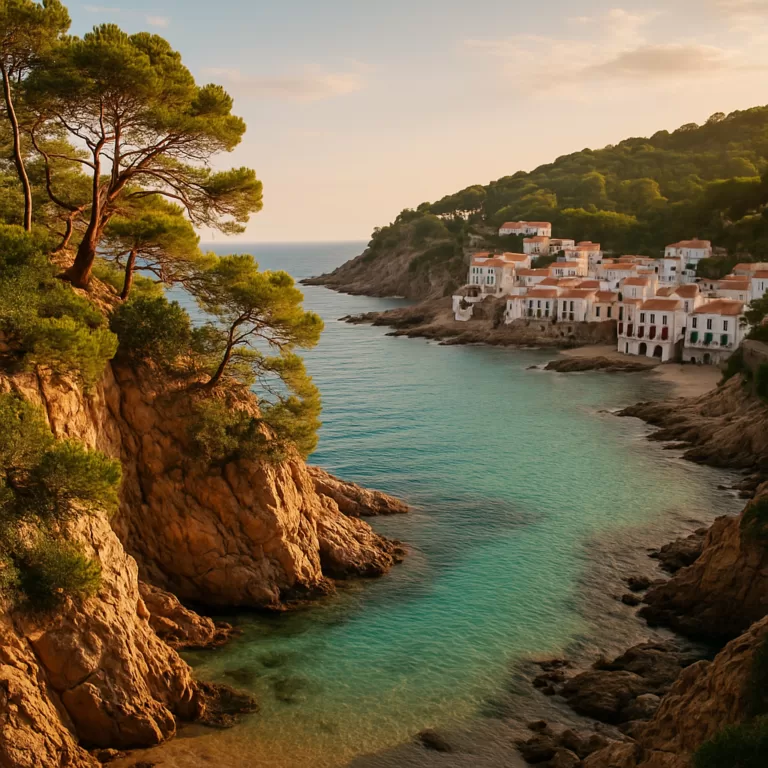
The Costa Brava — “the wild coast” — is the rugged northern stretch of Catalonia’s shoreline, running from Blanes to the French border. Instead of the long sandy resorts of southern Spain, it offers pine-clad cliffs, hidden coves and whitewashed villages, with the medieval city of Girona and Dalí’s Cadaqués close at hand. Here is an honest, grounded guide to where to go, what to eat, and what tends to disappoint.
At a glance
- Where: Girona province, Catalonia, north-east Spain.
- Gateways: Girona–Costa Brava Airport (GRO); Barcelona (BCN) is about an hour south by car, or roughly 40 minutes on the high-speed AVE train.
- Best for: rocky coves, dramatic scenery, Dalí, medieval towns and seafood — not big beach resorts.
- Headline stops: Tossa de Mar, Calella de Palafrugell, Begur, Cadaqués, Cap de Creus, Girona.
- Eat: fresh seafood and suquet (a Catalan fish stew); Girona is home to El Celler de Can Roca, repeatedly ranked among the world’s best restaurants.
- Getting around: a car is close to essential — the coast road is winding and the best coves are scattered.
Explore the Costa Brava on the map
Every place in this guide is a marker you can open for its own card. Tap a type — cove, town, viewpoint and more — to filter what you see.
Three things that surprise first-time visitors
- It’s coves, not one long beach. The appeal here is dozens of small rocky calas in clear turquoise water. They are beautiful, but many are reached on foot and fill quickly in summer.
- Lloret de Mar isn’t representative. The coast’s most famous name is a large, brash package-and-party resort. The prettier, quieter character lies further north, around Begur and Cadaqués.
- Cadaqués is a commitment. The loveliest village sits beyond a long, twisting mountain road — well worth it, but never a quick hop.
South and centre: Tossa de Mar and the Palafrugell coves
Tossa de Mar is the postcard of the southern Costa Brava, its walled medieval quarter — the Vila Vella — rising straight from the sea above a curved beach. Further up the coast, the villages around Palafrugell (Calella de Palafrugell and Llafranc) are whitewashed former fishing settlements turned low-key resorts, linked by the clifftop camí de ronda. Calella is also the heart of the havaneres tradition: each July, crowds gather on the shore for the famous Cantada d’Havaneres, sea shanties sung over glasses of flaming rum cremat.
North: Begur, Cadaqués and Cap de Creus
Around Begur lie some of the coast’s most celebrated coves — Sa Tuna, Aiguablava and Fornells — upmarket and strikingly pretty. Push further north, beyond that twisting road, and you reach Cadaqués. For centuries it was easier to reach by boat than over the mountains, and that isolation helped turn it into an artists’ haven in the 20th century: Salvador Dalí kept his home at neighbouring Portlligat (now a museum you book ahead to visit), and the village drew the likes of Picasso and Miró. Behind it, the Cap de Creus natural park forms the wild, rocky easternmost point of mainland Spain; marked trails cross its bare headlands to a lighthouse at the tip, past the wind-eroded rock formations that fed Dalí’s imagination.
Inland: Girona, food and the Greco-Roman past
Just inland, Girona is a highlight in its own right. Its remarkably preserved medieval old town climbs above a colourful riverfront and takes in one of Europe’s best-kept Jewish quarters, the Call, where the Museum of Jewish History records a community that thrived until the expulsion of 1492. A cathedral crowns the centre, reached by a sweeping flight of steps. The city is a serious food destination too, home to El Celler de Can Roca, and each May its Temps de Flors festival fills courtyards and monuments with flowers. Near the coast at L’Escala, the ruins of Empúries preserve a Greek and Roman town right beside the sea.
Which part of the Costa Brava is for you?
| Area | Character | Best for |
|---|---|---|
| Tossa de Mar | Medieval walled old town above a beach | A classic, easy first stop |
| Begur & its calas | Cluster of small rocky coves | The coast’s prettiest swimming, on foot |
| Cadaqués | Whitewashed village, Dalí’s former home | Art history and dramatic scenery |
| Cap de Creus | Wild, wind-scoured headland | Hiking and the wildest coastline |
| Girona | Medieval city, world-class dining | Culture and food, an easy day trip |
| Lloret de Mar | Large package-and-party resort | Nightlife — not representative of the rest |
When to go
The Costa Brava is a summer coast in the most literal sense — the coves that make it famous are small, and in July and August the popular ones fill up early in the day. June and September give warm swimming weather with far more room on the sand, and are also when Girona and Cadaqués are easiest to enjoy without queues. Winter here is genuinely quiet, closer to a Catalan off-season than a year-round sun coast; most visitors are chasing the coves and villages, not guaranteed winter warmth, so aim for late spring through early autumn.
A simple 3-day plan
- Day 1 — the southern coves. Tossa de Mar’s walled old town, then a stretch of the camí de ronda from Calella de Palafrugell to Llafranc.
- Day 2 — Girona. The medieval old town, the Call, the cathedral steps and dinner in a city that takes food seriously.
- Day 3 — the wild north. Begur’s coves, then over the mountain to Cadaqués and the Cap de Creus headland.
Local tip
Walk a stretch of the camí de ronda, the footpath that threads between coves. The short section from Calella de Palafrugell to Llafranc is especially scenic and reaches small beaches you simply cannot drive to.
Reality check
In July and August the coast is busy, and coves, parking and the prettiest villages fill up fast. Spring and early autumn are far calmer, with a warm sea and quieter paths. This is not a winter-sun coast — it sits further north and goes quiet out of season — and if an all-inclusive beach resort is what you’re after, only the southern end really delivers it.
Verdict
Come to the Costa Brava for scenery, coves and character rather than resort life. Base yourself around Begur or Palafrugell, give Girona a full day, and make the trip north to Cadaqués and Cap de Creus — that combination shows the wild coast at its best.
How we assess
This guide is compiled and cross-checked from established, verifiable information about each place — geography, history, headline sights, food and how they connect; travel times are checked against current sources. We don’t invent first-hand fieldwork or personal anecdotes; where something is a matter of taste or changes by season, we say so plainly. Place names use correct Catalan and Spanish spelling and accents.
Getting around once you’re here
Girona–Costa Brava Airport is the closest gateway, but it is a small regional airport with a limited route map, so many visitors still fly into Barcelona and drive up, or take the AVE high-speed train to Girona and hire a car from there. Once you arrive, a car is genuinely close to essential: the coast road twists constantly, public buses between the small cove towns are infrequent, and several of the best calas are only reachable by a short walk from the nearest parking area. If you want to stay car-free, base yourself in Girona itself and treat the coast as a series of day trips rather than trying to move between coastal villages on local transport.
Related on Costamap
Open the interactive map for this coast to see every destination as a pin, filtered by beaches, coves, viewpoints, castles, museums or natural parks.
Immediately south, the Costa Barcelona covers the Maresme, the Garraf cliffs and the Penedès cava country either side of the city.
Every town guide on the Costa Brava
31 towns on this coast have their own guide on CostaMap. They are listed alphabetically, with what each one is actually for.
- Alella — a small wine town just north of Barcelona
- Arbúcies — bus-building heritage, chestnut forests, hiking trails, local food, and how to get there
- Arenys de Mar — a Maresme coast town with the area’s biggest marina
- Banyoles — The Estany de Banyoles is the biggest natural lake in Catalonia and hosted
- Begur — medieval hilltop village above Costa Brava’s finest coves: Sa Riera, Sa Tuna, Aiguablava
- Besalú — one of Catalonia’s best-preserved medieval towns
- Bescanó — a quiet Ter-river town just west of Girona
- Blanes — where the Costa Brava begins: Sa Palomera rock, Marimurtra botanical garden, long beaches
- Cadaqués — the white fishing village Dalí called home: Portlligat, Cap de Creus, slate coves
- Caldes de Malavella — Roman thermal baths, Vichy Catalan water, golf at PGA Catalunya
- Canet de Mar — Domènech i Montaner’s modernism, Castell de Santa Florentina and a summer music festival
- El Masnou — golden beaches, a lively marina, maritime heritage and easy trains from Barcelona
- Escala — the Greek and Roman ruins of Empuries, salted anchovies
- Figueres — the Dalí Theatre-Museum, the vast Sant Ferran castle
- Girona — a walled medieval old town, the widest Gothic cathedral nave
- Hostalric — medieval walls, castle and old town between Girona and Barcelona
- Lloret de Mar — Lloret de Mar is the Costa Brava’s biggest, busiest resort
- Malgrat de Mar — history, the Cathedral of the Coast and how to visit
- Olot — capital of the Garrotxa volcanic zone, dozens of dormant volcanoes
- Palafrugell — gateway to Calella de Palafrugell, Llafranc and Tamariu: cork heritage, havaneres
- Palamós — a working Costa Brava fishing town famous for its prawns
- Pineda de Mar — long Maresme beaches, a Roman aqueduct and direct trains from Barcelona
- Premià de Mar — a Maresme beach town 30 minutes by train from Barcelona
- Roses — sweeping bay beaches, the Ciutadella fortress, boat trips to Cap de Creus, food
- Salt — a dense, multicultural mill town on Girona’s doorstep
- Sant Antoni de Calonge — a long Costa Brava beach, quiet coves
- Sant Feliu de Guíxols — Costa Brava harbour town with a Benedictine monastery, Sant Pol beach
- Santa Coloma de Farners — Full guide to Santa Coloma de Farners
- Tordera — an inland town on the Costa Brava’s southern edge, its river delta
- Torroella de Montgrí — medieval planned town under the Montgrí castle
- Tossa de Mar — Tossa de Mar on the Costa Brava has a walled medieval old town
See the full Costa Brava region guide for the interactive map of every beach, town and historic site along this coast.
Frequently asked questions
When is the best time to visit?
Late spring (May–June) and early autumn (September) bring warm weather and sea with smaller crowds than the July–August peak. May also brings Girona’s Temps de Flors.
Do I need a car?
Effectively yes. The coves and northern villages are spread out and poorly linked by public transport, so a car makes the Costa Brava far easier.
How many days do you need?
Three days covers the highlights: a day on the southern coves and the camí de ronda, a day in Girona, and a day north to Cadaqués and Cap de Creus.
Is Lloret de Mar worth it?
It depends what you want. Lloret is a large, lively package resort; for the quieter, scenic coast, head north to Begur, Palafrugell and Cadaqués.
How does it compare to southern Spain?
It’s cooler, greener and more about coves and culture than wide sandy beaches and winter sun — a different mood entirely.
Plan your trip
Use the map above to open each place, or see the full Costamap map of every Spanish costa. Staying in Catalonia? The Costa Dorada lies further south, beyond Barcelona.
Every place we have mapped on the Costa Brava
56 towns, beaches, coves and landmarks, kept up to date automatically.
- Aiguamolls de l'Empordà Natural Park
- Begur
- Cadaqués
- Calella de Palafrugell
- Cap de Creus
- Ciutadella de Roses
- Cork Museum of Palafrugell
- Empúries
- Girona
- Iberian Town of Ullastret
- La Fosca
- Llafranc
- Salvador Dalí House Museum
- Tossa de Mar
- Water World Lloret
- Alella: Wine Town on the Barcelona Coast
- Anglès: Riverside Textile Town in the Guilleries
- Arbúcies: Montseny Mountain Town Near Costa Brava
- Arenys de Mar: Maresme Marina and Beaches
- Argentona: Maresme spring-water town near Mataró
- Banyoles: Lake Town in the Pla de l'Estany
- Begur: Hilltop Village & Hidden Coves of Costa Brava
- Besalú: Medieval Town and Romanesque Bridge
- Bescanó: a quiet Ter-river town at the gateway to Girona
- Blanes: Gateway to the Costa Brava
- Breda: Pottery and Monastery Village
- Cadaqués: Dalí's White Village on Cap de Creus
- Caldes de Malavella: Thermal Springs Town on Costa Brava
- Canet de Mar: Maresme Beach Town of Modernist Architecture
- Cassà de la Selva: cork-country town near Girona
- El Masnou: Maresme Marina Town Guide
- Escala: Empuries, Anchovies and Costa Brava
- Figueres: Dalí Museum and Old Town
- Girona: Medieval Old Town and Onyar Houses
- Hostalric: Medieval Walled Town Behind the Costa Brava
- Lloret de Mar: Beaches, Old Town and the Costa Brava's Busiest Resort
- Maçanet de la Selva: Castle Ruins and Selva Countryside
- Malgrat de Mar: Beach Resort on the Maresme Coast
- Olot: Volcanoes and Garrotxa Nature
- Palafrugell: Calella, Llafranc & Tamariu Coves
- Palamós: Costa Brava Fishing Port and Beaches
- Pineda de Mar: Maresme Beaches and Roman Aqueduct
- Premià de Mar: strand, Maresme og romersk arv
- Riudarenes: Rural Selva Village Near the Costa Brava
- Roses: Beaches, Bay & Cap de Creus on Costa Brava
- Salt: Coma-Cros, kultur og Girona rett ved
- Sant Antoni de Calonge
- Sant Feliu de Guíxols: Monastery Town on Costa Brava
- Sant Hilari Sacalm: Spa Town in the Guilleries Hills
- Santa Coloma de Farners: Inland Costa Brava Guide
- Sils: Lake Heritage and Village Life in La Selva
- Tordera
- Torroella de Montgrí: Medieval Town & L'Estartit Beaches
- Tossa de Mar: Medieval Walls, Beaches and the Costa Brava's Prettiest Bay
- Vidreres: Country Charm Between Lloret and Girona
- Vilassar de Mar: Maresme Coast Town Guide
How this page is maintained. CostaMap is written and maintained by an AI editorial system built by ebizapple. Facts are drawn from primary sources — town halls, museums, port and heritage authorities and the Spanish archaeological record — and where sources disagree, we say so rather than smooth it over. Photographs marked as ours are taken on location. This page was last reviewed on 11 August 2026. Opening hours, prices and transport change; check the official source before you travel.