
Salt is an inland town of about 34,600 people that adjoins Girona, with no beach of its own. It suits visitors who want a base next to Girona, with a former textile factory turned cultural centre and walks by the river Ter, and who are happy to reach the Costa Brava by bus or car. If you want sand outside your door, stay on the coast instead. Salt is part of our Costa Brava guide, and the old town of its neighbour has its own page: Girona.
Quick facts
- Where: Salt, comarca of the Gironès, province of Girona, Catalonia. The river Ter forms the northern edge of the municipality.
- Residents: 34,491 (1 January 2025, INE), on 6.64 km² at 83 m above sea level (Idescat).
- Beach: none. The Carrilet II greenway runs 41.9 km from Girona to Sant Feliu de Guíxols on the coast, which gives a measure of the distance.
- Nearest airport: Girona–Costa Brava (GRO), 10 km from Girona and 85 km from Barcelona, according to Aena.
- Next to: Girona, which is 100 km from Barcelona and 65 km from the French border (Girona city council).
- Language: the town council and tourism websites are in Catalan; Spanish is also widely used.
- Markets: a street market on Wednesday and Friday mornings, and an indoor market open Monday to Saturday mornings.
- Known for: the Coma-Cros factory, now a cultural centre, and a textile past built on the river and the Monar channel.
Where to base yourself
Salt covers only 6.64 km², so the choice is less about distance and more about what you want to be near. Treat these as three practical options, not formal districts.
Around Coma-Cros
The former factory sits in the Veïnat district and now holds a library, a music school, performing-arts space and a water museum. Staying near it suits visitors who come for culture, concerts or a long stay rather than sightseeing, and who plan to commute into Girona.
The old quarter
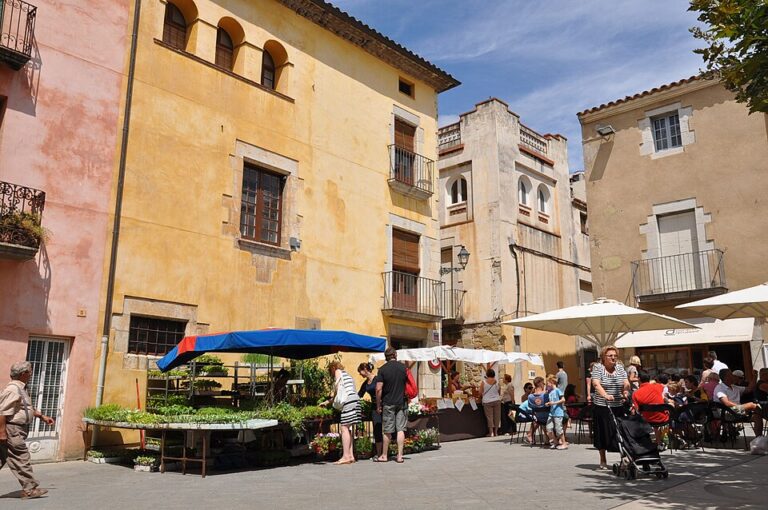
The town’s own tourism site places the basket fair in the heart of the Barri Vell, and there is an indoor market. This is the area for everyday shops and bars, and for seeing Salt as a town people live in rather than a destination.
Girona itself
If your plan is mainly the cathedral, the Jewish quarter and the old town, sleeping in Girona removes the commute. Salt makes sense when you want a base on the edge of the city and plan to use the bus. Prices were not checked for this guide, so compare current offers for both.
Things to do
Salt is not a sightseeing destination in the way Girona is. The reasons to visit are a few specific places, and none needs more than a morning.
Coma-Cros cultural factory
The Coma-Cros company bought a textile factory in Salt on 22 May 1866, and Joan Coma i Cros became its sole owner in 1893. The Salt plant spun and wove cotton. In 1990 the company was absorbed by Indústries Burés, and the buildings were later rehabilitated over about 20 years into the cultural centre you can visit today at Carrer Sant Antoni 1. It houses a library, El Canal, ERAM, the Escola de Música Moderna, the UOC, the Ateneo Popular and the Museu de l’Aigua. The water museum looks at how water shaped Salt’s farming, textile factories and power plants.
Industrial heritage along the channel
Textile firms came to Salt for the water power of the Ter and the Monar channel, which a Catalan encyclopedia entry calls the axis of industrialisation around Girona. The first textile factory in the centre of Salt was founded in 1846 and later grew into the Gassol complex, a 55,000 m² site that the town council bought in 2021. It is a ruin of a working past rather than a finished attraction, so go to look from outside and read about it first.
Walks, rides and the Ter
The tourism site lists four marked running routes of 4.2 km, 4.2 km, 7.61 km and 7.34 km, plus walks, cycling routes towards Llagostera and Anglès, kayaking on the Ter and the Parc de les Deveses. The Vies Verdes greenways pass nearby. For an easy first outing, the park and the river edge need no planning.
Theatre and music
Salt describes itself as a town with a theatre tradition. Teatre de Salt is part of the Temporada Alta autumn festival, La Mirona is a concert hall with more than a hundred concerts a year, and the Black Music Festival takes place every year. Check the town agenda for what is on during your dates.
Fairs through the year
The town runs several fairs: the International Basket Fair in the old quarter, a flower and plant fair at the Parc del Rec Monar, a textile fair beside Coma-Cros and a food-truck fair. The tourism site gives no year for these, so look at the Salt event calendar before you plan around one.
Beaches and places nearby
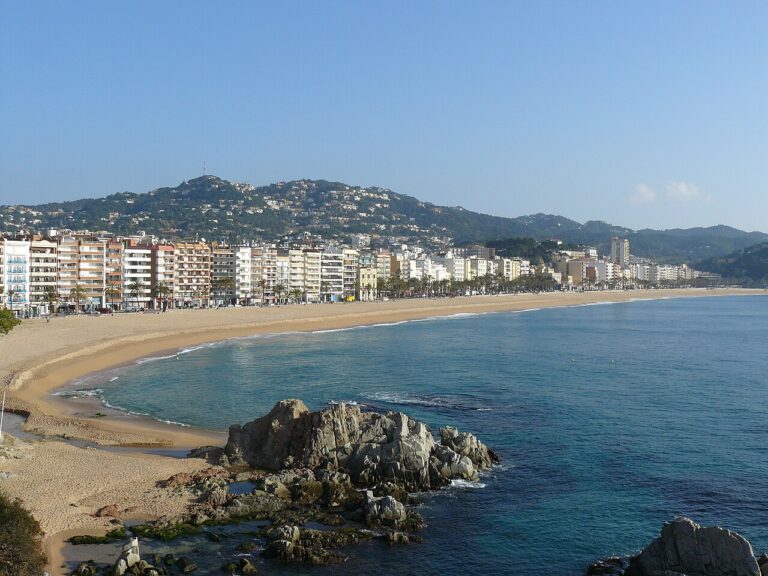
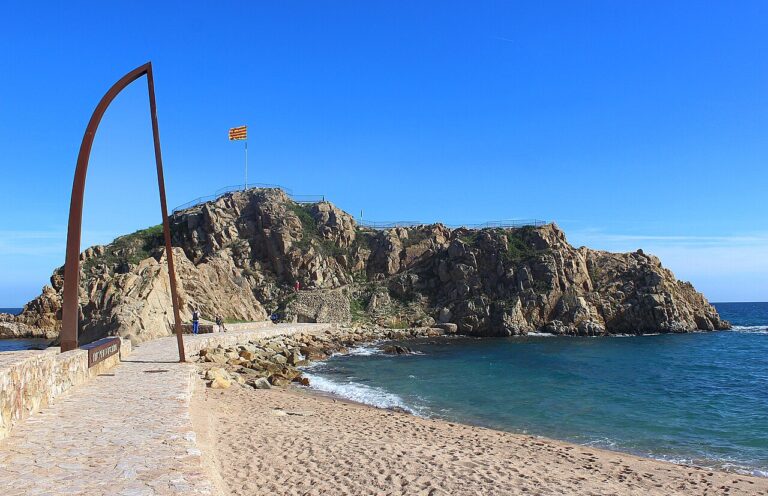
Be clear about this before you book: Salt has no beach, and the sea is not a short walk away. The Carrilet II greenway from Girona to Sant Feliu de Guíxols is 41.9 km long, and it passes Cassà de la Selva, Llagostera and Santa Cristina d’Aro on the way. For a day by the water, the nearest coastal towns with their own guides are Sant Feliu de Guíxols, Blanes, Lloret de Mar and Tossa de Mar. Inland, Banyoles, Olot and Figueres make other day trips from Girona.
If you came to Salt only because it is cheaper than the coast, plan on a hire car or bus connections each beach day. If you want a beach holiday, skip Salt.
Other town guides nearby: Besalú (about 26 km in a straight line), Torroella de Montgrí (about 29 km in a straight line), Palamós (about 31 km in a straight line).
Food and drink
Everyday food in Salt means markets and neighbourhood restaurants rather than a single dish to travel for. The indoor Mercat de Salt has stalls on Monday to Saturday mornings and on Thursday and Friday afternoons, and the town describes it as modern with free parking. The street market, the Mercat de Marxants, runs on Wednesday on Passeig Ciutat de Girona and on Friday on Rambla de la Maçana. Salt’s tourism site lists neighbourhood shops and restaurants and the Espai Gironès shopping centre. For a wider choice of places to eat, most visitors walk or take the bus into Girona.
Where to stay
The town tourism site keeps its own list of hotels in Salt, and Girona and the coast offer further choice. Prices vary with season and event dates and were not checked for this guide, so compare current offers before committing. If you rely on public transport, choose somewhere near a bus line to Girona; if you drive, free parking is mentioned for the indoor market, but check parking at any place you book.
Getting there and around
Girona–Costa Brava Airport is the closest, 10 km from Girona and 85 km from Barcelona, and it handled over two million passengers in 2025 (Aena). The Costa Brava tourism board says the high-speed train (AVE and TGV) stops at Girona and Figueres, and that Barcelona is under an hour away by train. The same board says the airport is a 90-minute train or 60-minute car journey from Barcelona–El Prat.
Salt has its own bus network operated by Teisa, with lines L3, L4 and L9 on the municipal site; the L3 and L4 buses are adapted for reduced mobility. The town site does not mention a train station in Salt, so for trains you use Girona. For the coast, a car gives the most freedom; the Carrilet II greenway is a cycling and walking option for the first stretch towards Sant Feliu de Guíxols. Check current timetables with the operators.
Best time to visit
Climate figures here come from the AEMET station at Girona Airport (1981–2010 normals), not from Salt itself. The annual mean is 14.7 °C and annual rainfall is 728 mm. January averages 7.1 °C with a daily maximum of 13.1 °C. July averages 23.6 °C with a daily maximum of 30.1 °C and is the driest month at 32 mm, while October is the wettest at 88 mm.
The town’s fairs and festivals are the reason to time a trip, but the tourism site gives no year for them. Check the Salt event calendar for your dates. Culture runs through the year, and the Temporada Alta festival is described as the autumn festival of Catalonia for Salt and Girona.
FAQ
Does Salt have a beach?
No. Salt is inland next to Girona. The Carrilet II greenway from Girona to Sant Feliu de Guíxols is 41.9 km long, so plan for a bus or car to reach the coast.
Is Salt worth visiting as a tourist?
For most people it is a base or a short stop, not a destination. The Coma-Cros cultural factory and its water museum are the clearest reasons to go, along with walks by the Ter.
Is Salt a good base for Girona?
It can be, if you want a quieter or longer stay next to the city and accept a bus ride in. If your trip is only the old town of Girona, sleeping in Girona itself is simpler.
When are the markets in Salt?
The street market runs on Wednesday and Friday mornings, and the indoor market is open Monday to Saturday mornings plus Thursday and Friday afternoons, according to the town’s tourism site. Check the site for changes.
Which airport is closest to Salt?
Girona–Costa Brava Airport, which Aena places 10 km from Girona. Barcelona–El Prat is the other main option; the Costa Brava tourism board puts Girona airport 90 minutes from it by train or 60 minutes by car.
Sources and freshness
- INE, population of Girona municipalities: population
- Idescat, Salt municipality in figures: area, altitude
- Viu Salt, town tourism site: fairs, culture, markets, routes, buses
- Enciclopèdia Catalana, Coma-Cros in Salt: company history
- Ara, Gassol factory in Salt: Gassol site, Coma-Cros reuse
- Factoria Cultural Coma Cros: address
- Femturisme, Salt: water museum, location
- Vies Verdes, Carrilet II: greenway length
- Aena, Girona–Costa Brava Airport: distances, passengers
- Costa Brava Girona tourism board, how to get there: train and airport
- Girona city council, tourism: distances from Girona
- AEMET, Girona Airport climate normals: temperature and rainfall
Last checked: October 2026.
Nearby on the Costa Brava

Salt Girona on the map
Places worth knowing near Salt Girona
How this page is maintained. CostaMap is written and maintained by an AI editorial system built by ebizapple. Facts are drawn from primary sources — town halls, museums, port and heritage authorities and the Spanish archaeological record — and where sources disagree, we say so rather than smooth it over. Photographs marked as ours are taken on location. This page was last reviewed on 29 October 2026. Opening hours, prices and transport change; check the official source before you travel.