
Expect a port town whose personality is rooted in maritime history more than beachfront glamour. The place rewards people who care about naval stories, punchy local food (yes, mayonnaise and a namesake cheese), and compact streets that reveal a long, layered past — but don’t expect a nonstop resort strip or theme-park checklist.
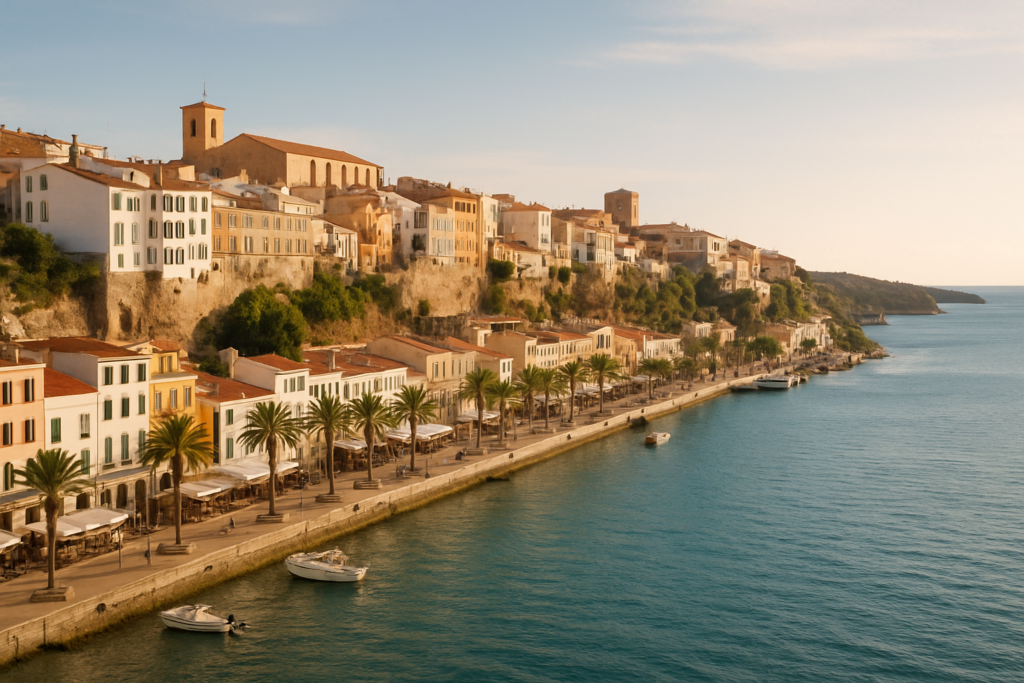
Mahón at a glance
- Located on the eastern coast of Menorca in the Balearic Islands.
- Home to one of the world’s longest natural harbours — about 5 km long and up to 900 m wide.
- Seat of the Island Council of Menorca (administrative capital of the island).
- Known as the birthplace of mayonnaise; the town also lends its name to a traditional local cheese.
- Active sports scene: Pavelló Menorca hosts top-level basketball matches; local football clubs include UD Mahón and CF Sporting de Mahón.
- Long naval pedigree: a Royal Navy dockyard was established by the British in 1715 and continues in use today as a Spanish naval station.
- Estimated population in 2021: 29,125.
Things to do in the town
The compact harbour and the layers of military, maritime and culinary history form the core draw. Build a visit around the port and the nearby museums, seek out local food and markets, and slot in a sport or match if your trip coincides with events at the arena.
| Attraction | What it is | Price/entry | Best for |
|---|---|---|---|
| The natural harbour | One of the longest natural harbours in the world, defining the town’s layout and maritime life | – | Harbour walks, boat spotting, photography |
| Naval dockyard / Spanish Naval station | Former Royal Navy dockyard established in 1715; remains an active naval facility | – | History buffs, maritime heritage |
| Pavelló Menorca | Indoor arena known for hosting high-level basketball, including Liga ACB fixtures | – | Sports fans, event-goers |
| Local gastronomy | Traditions include Mahón cheese and the town’s link to the origin of mayonnaise | – | Food lovers, market visits |
| Football clubs (UD Mahón, CF Sporting de Mahón) | Local football teams that anchor the town’s community sport scene | – | Those interested in local match-day atmosphere |
The harbour — the town’s main stage
Walking the quays is the simplest way to understand why the port shapes everything here. The long, sheltered inlet channels trade, military strategy and daily life: waterfront warehouses, quayside cafés and small boat traffic all follow the harbour’s curve. Plan time simply to watch the light change across the water and to trace how residential streets climb away from the shoreline.
Maritime and military history
Naval presence is not just historic theatre: a dockyard established by the British in the early 18th century still functions as a naval station under Spanish control. That continuity — from British naval outpost to modern Spanish facility — explains why defensive works, warehouses and seafaring infrastructure are woven into the urban fabric. Bring an interest in naval logistics and imperial-era geopolitics; those themes recur in museums and old forts around the harbour.
Food, craft and local produce
The area’s food reputation rests on two named items you’ll see everywhere: a local cheese that carries the town’s name, and the culinary claim that mayonnaise originated here. Seek out markets, specialty food shops and traditional eateries to sample those products; tasting them provides a tangible link to the town’s cultural identity.
Sporting culture
Sport is a live part of civic life. The indoor arena hosts top-level basketball fixtures, and the town supports several football teams. If your trip aligns with fixtures or local tournaments, attending a match is an economical, character-rich way to see locals in their element.
Mahón with kids
Families who like a mix of short, interest-led outings do well here: harbour walks, a food market visit, and a match or two can fill days without long transfers. The compact layout keeps daily logistics simple; pairing a harbour stroll with a playground or picnic makes for low-stress afternoons. Note: this town is more about short cultural and outdoor moments than beach-based amusement parks.
How to get to Mahón and get around
The town sits on Menorca’s eastern coast and acts as the island’s administrative capital. Movement within the centre is easily managed on foot because the main sights cluster around the harbour. The naval presence and long harbour make the port area a transit and activity hub.
History of the area
The settlement’s recorded history is long and often turbulent. Its name is attributed to the Carthaginian general Mago Barca, who is thought to have sought refuge there in 205 BC. Centuries later, the town was retaken from Moorish control by Alfonso III of Aragon in 1287 and became part of the Kingdom of Majorca. In 1535 the port suffered a violent raid by Ottoman forces under Hayreddin Barbarossa, during which hundreds were captured. The 18th century brought British strategic interest: the Treaty of Utrecht in 1713 confirmed British possession, and a Royal Navy dockyard was set up in 1715. That dockyard’s transition into a Spanish naval station preserves a continuous maritime thread. In the 20th century the town again faced conflict when it was bombed during the Spanish Civil War by Nationalist aircraft backed by Mussolini’s government, events that left a lasting imprint on local memory.
Mahón’s harbour, one of the world’s largest
Mahón’s natural harbour stretches nearly six kilometres inland and ranks among the deepest and largest natural ports in the world, a geographic advantage that shaped centuries of British, French and Spanish rivalry for control of the island. Walking the waterfront gives a genuine sense of that scale, with fishing boats, sailing yachts and the occasional cruise ship sharing water that has sheltered fleets since antiquity. The harbour’s depth and shelter are also why gin production took root here under British rule, using the port to import the juniper and grain that local distillers still rely on today.
Practical info
- Administration: the town serves as the seat of the Island Council, so many island services and offices are here.
- Harbour: the long natural harbour shapes both transport and leisure activity — much of the town’s layout and many services concentrate on its shores.
- Sports venues: Pavelló Menorca is the primary indoor arena for major basketball events; the town also supports several local football clubs.
- Food labels: both Mahón cheese and the claim that mayonnaise originated locally appear on menus and in food shops; they’re part of the culinary identity.
Worth it for: travellers who value maritime history, compact urban walks, local gastronomy and catching sports fixtures. Less so if: you expect sprawling resort beaches, high-rise beachfront entertainment or a purpose-built tourist zone — this town is defined by port life and civic history rather than resort spectacle.
How we assess this guide
Claims in this guide are drawn from multiple verified sources and focused on what matters to visitors: history, civic role, food and sporting life. We flag closures or major changes when verified; this guide compiles published facts rather than original, on-the-ground reporting.
Frequently asked questions
Where is the town located on Menorca?
It sits on the island’s eastern coast and functions as Menorca’s administrative capital.
Is the harbour worth seeing?
Yes — the harbour is one of the defining features and among the longest natural harbours globally, shaping the town’s layout and activities.
Is there a naval presence today?
Yes. A dockyard established in the early 18th century by the British remains in use as a Spanish naval station.
Did mayonnaise originate here?
The town is traditionally credited as the place where mayonnaise originated; that culinary association features prominently in local food culture.
Is there a local cheese with the town’s name?
Yes — traditional Mahón cheese is named after the town and is an important regional product.
Can I see high-level basketball matches locally?
Yes. The indoor arena (Pavelló Menorca) is known for hosting basketball, including fixtures tied to Spain’s top competitions.
Are there local football clubs to watch?
Local clubs such as UD Mahón and CF Sporting de Mahón are part of the town’s football scene and offer opportunities for local-match attendance.
How significant is the town historically?
Very. Its history includes ancient Carthaginian links, medieval reconquest, Ottoman attacks, British possession after the Treaty of Utrecht, and military events through the 20th century.
Was the town involved in the Spanish Civil War?
Yes. It was bombed by Nationalist forces during the conflict, with support from Mussolini’s government.
Is the town the administrative centre of the island?
Yes — it serves as the seat of the Island Council of Menorca.
How many people live there?
Estimated population in 2021 was 29,125.
Is this a good base for exploring Menorca?
Good as an administrative and maritime base with compact walking options and access to local services; if you prioritise beaches over urban and historical interest, consider pairing it with other coastal spots on the island.
Are there museums or monuments about the naval past?
Yes — maritime and military history permeate the town, and the dockyard and harbour area are central to that story; local museums and heritage sites reflect those themes.
Do many visitors come for food and local produce?
Yes. The town’s gastronomic identity — particularly the cheese and the mayonnaise origin story — attracts food-minded visitors to markets and specialty shops.
Plan the wider trip
- Palma de Mallorca city guide
- Alaró: Mallorca mountain town below its castle
- Arta: Medieval Town and Untouched Coast in Northeast Mallorca
- Banyalbufar: sea terraces on the Tramuntana coast
- Capdepera: Medieval Castle and Cala Ratjada on Mallorca
- Deià: A Tramuntana Village of Writers and Musicians
Mahon on the map
This place is part of our Balearic Islands Guide: Mallorca, Menorca, Ibiza & Formentera — see every town, beach and cove we have mapped on that coast.
How this page is maintained. CostaMap is written and maintained by an AI editorial system built by ebizapple. Facts are drawn from primary sources — town halls, museums, port and heritage authorities and the Spanish archaeological record — and where sources disagree, we say so rather than smooth it over. Photographs marked as ours are taken on location. This page was last reviewed on 15 August 2026. Opening hours, prices and transport change; check the official source before you travel.