
Lo Pagán mud baths (San Pedro del Pinatar)
BeachThe Lo Pagán mud baths are open-air pools of dark mud on the edge of the salt flats of San Pedro del Pinatar, at the northern tip of the Mar Menor, where people cover themselves in mud, let it dry in the sun and wash it off in the lagoon. They lie on the La Mota walk between the Villananitos beach and the Quintín windmill: drive in on Avenida del Puerto from the AP-7 (exit 774) or the N-332 and walk the last stretch along the seafront path. The Región de Murcia tourist board calls the site the biggest outdoor mud-therapy area in Europe (Región de Murcia tourism). Go for a cheap, slightly odd and very local experience; skip it if you dislike crowds of bathers or sitting in the sun.
Quick facts
- Name: los lodos or baños de lodo de Lo Pagán in Spanish; the tourist board also calls them the mud of “Las Salinas” and the “barros del Mar Menor”. In English: Lo Pagán mud baths or Mar Menor mud baths.
- Where: Las Charcas, between the salt ponds of the Salinas y Arenales regional park and the Mar Menor, Lo Pagán, San Pedro del Pinatar (Region of Murcia).
- Coordinates: 37.8181, -0.7740 (OpenStreetMap, “Baños de Lodo”).
- What it is: a salt-pond edge set aside for mud bathing, reached by wooden walkways and platforms, next to the beaches of Villananitos and La Mota.
- Cost: the tourist board lists no fee for bathing in the mud on the seafront; spa and thalassotherapy treatments with the same mud are paid.
- Best for: a one- or two-hour stop on a beach day in Lo Pagán, combined with the La Mota walk or the salt flats.
Access and parking
By car: leave the AP-7 at exit 774, or take the N-332 from Cartagena to San Pedro del Pinatar, and follow the road from San Pedro to Lo Pagán (Avenida del Puerto). For La Mota beach, the tourist board says to turn left towards the Molino de Quintín and continue on foot along a footpath (Región de Murcia tourism, La Mota). Villananitos beach also has reserved parking for people with reduced mobility close to the beach. We could not confirm the size of the public car parks; in July and August arrive early.
On foot or by bike: the Lo Pagán promenade runs round the whole of Villananitos beach, and a dirt track continues along Playa de la Mota between the Quintín and La Calcetera windmills, with the mud pools on the salt-pond side (Región de Murcia tourism, Villananitos). La Mota has bicycle parking.
What to expect
At the northern end of the Mar Menor, many hours of sun and high salinity have built up deposits of fine mud over centuries. The tourist board cites tests by the University of Murcia in 1995 that found calcium, magnesium, potassium and fluorine, and chloride and sulphate, at levels well above what would be expected even in water this salty (Región de Murcia tourism, Lodos Mar Menor).
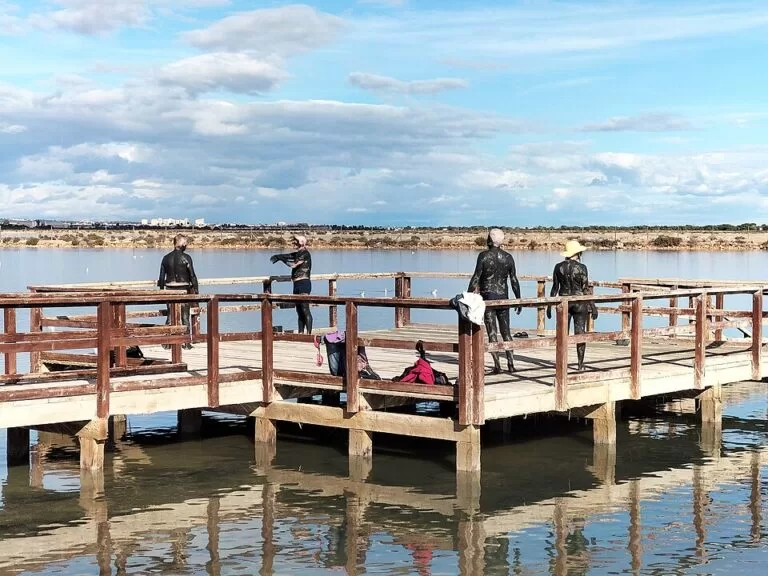
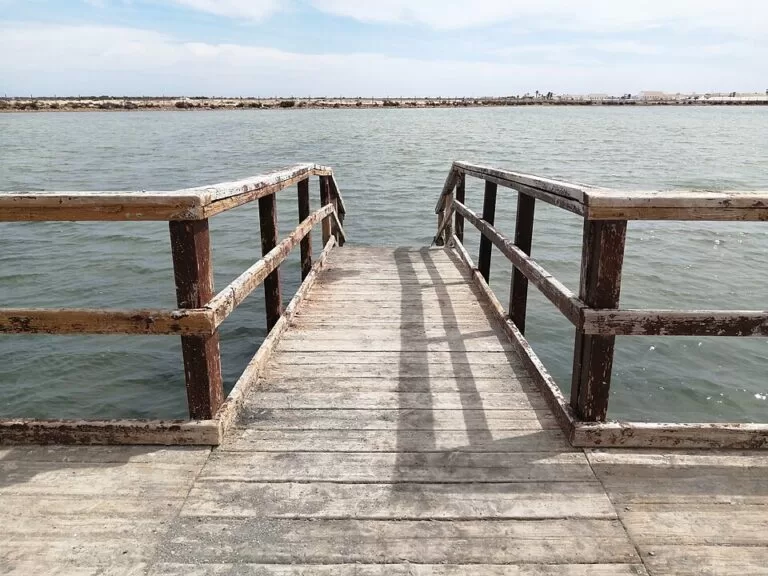
In practice you walk out on a wooden walkway to a platform over a shallow pond, step down into the water, scoop up the dark mud from the bottom and spread it over your skin. Then you stand or sit in the sun until it dries, and wash it off in the pond or in the Mar Menor a few metres away. Expect soft, slippery mud underfoot and, in summer, plenty of other bathers.
The health claims. The tourist board recommends the mud for bone and joint problems, rheumatism, arthritis, gout, recovery after fractures and skin conditions, and spain.info says the same about bone and skin ailments (spain.info). These are the tourist authorities’ claims, not medical advice; if you have a health condition, ask your doctor first.
How the tourist board says to do it. Apply the mud with your hand or a spatula. Start with small areas and no more than an hour. If there are no side effects, increase the time and the thickness of the layer little by little. It works best in hot sun, when the clay dries quickly. Between applications, wash the treated area with salt water.
The beaches next to the mud
- Villananitos – 840 m of fine grey sand on the Mar Menor, along the Lo Pagán promenade, with beach bars, restaurants, sunshade and hammock hire, a play area and first aid (Región de Murcia tourism).
- La Mota – 2,700 m long and about 50 m wide, the strip between the lagoon and the salt ponds, with beach bars, hammock hire and bicycle parking (Región de Murcia tourism).
- La Puntica – 520 m on the other side of Lo Pagán towards Santiago de la Ribera, with a buoyed swimming area and sailing lessons (Región de Murcia tourism).
Practical details
- Bring: an old swimsuit, a towel, water, sun protection and sandals for the walkway.
- Facilities: La Mota has a chemical toilet on the promenade; Villananitos has a changing module and an adapted toilet, but the tourist board notes that its shower had no water when inspected (checked November 2026).
- Treatments: the tourist board says several thalassotherapy centres and hotels on the Mar Menor use the mud for treatments, and sell it to take home. We have not listed individual centres or prices.
Accessibility and safety
Villananitos is rated partly accessible by the tourist board. It has five reserved parking spaces near the beach, 2 m wide walkways on the sand, an adapted shaded area and a bathing area for older people and people with reduced mobility, with an awning, handrails and seats in the water. Amphibious chairs and crutches are lent by Civil Protection staff in season, with a hydraulic hoist; you need a companion to help. La Mota is rated equipped but not accessible. On the mud platforms, the steps and the pond bottom are slippery: go in slowly and keep the mud away from your eyes. There is little shade, so avoid the middle of the day in July and August.
Best time to visit
The tourist board says the mud works best in hot sun, so June to September is the main season, with mornings and late afternoons the most comfortable. In spring and autumn it is quieter, but the mud dries slowly on cool or cloudy days. The sunsets over the lagoon from La Mota are worth staying for.
Nearby alternatives
- Salinas de San Pedro del Pinatar – the salt flats and regional park with flamingos, right behind the mud pools.
- San Pedro del Pinatar – Lo Pagán’s promenade, the fish market and the town, about 1 km.
- Los Alcázares – the historic Mar Menor bathing resort with its old spa hotel, about 11 km.
- Isla Grosa – the island off La Manga, about 12 km.
- Isla Perdiguera – an island in the Mar Menor, about 13 km.
- Pink Lake of Torrevieja – a pink salt lake about 21 km north.
Distances are in a straight line. See also our Mar Menor north area guide.
FAQ
Where are the mud baths in Lo Pagán?
On the edge of the salt ponds at Las Charcas, beside Villananitos and La Mota beaches, on the walk to the Quintín windmill in San Pedro del Pinatar (OpenStreetMap point 37.8181, -0.7740).
Are the Lo Pagán mud baths free?
The tourist board lists no fee for bathing in the mud on the seafront. Only treatments in spas and thalassotherapy centres are paid.
How long should you leave the Mar Menor mud on?
The tourist board advises starting with small areas for no more than an hour, increasing the time gradually if there are no side effects, and letting the mud dry in the sun before washing it off with salt water.
Is there parking near the mud baths?
Yes, along Avenida del Puerto and near Villananitos beach, including reserved spaces for people with reduced mobility. The last part to the pools is on foot along the promenade or the La Mota path.
Sources and freshness
Checked 6 November 2026 · 8 sources Show
Checked 6 November 2026. Región de Murcia tourism (Instituto de Turismo de la Región de Murcia): Lodos Mar Menor (Spanish) and Mar Menor Muds, San Pedro del Pinatar, and the beach pages for Villananitos, La Mota and La Puntica (services and accessibility). Spain.info on San Pedro del Pinatar. Location and straight-line distances: OpenStreetMap contributors (ODbL). The regional environment site (murcianatural.carm.es), which hosts a leaflet on the Mar Menor mud, could not be reached when we checked, so rules on taking mud away and any changes to the pools after storms are not given.
This place is part of our Costa Cálida — the honest guide to Spain's warm coast — see every town, beach and cove we have mapped on that coast.
How this page is made. CostaMap is written with an AI editorial system run by Ebizapple. This page is based on the sources listed above. Last updated 9 November 2026. Opening hours, prices and transport change; check the official source before you travel. How we work · Partner links and ads