
Expect a small, low-key coastal town with a river — yes, a river — and a relaxed family-friendly feel rather than Ibiza’s headline nightlife. This is where history and gentle seaside life meet: a fortified hilltop church, a modest marina at one end of the bay, beaches geared to families, and a quietly celebrated local artistic legacy. If you arrive looking for calm days on sand, safe swimming and strollable streets, you’ll be in the right place. If you come expecting all-night parties, look elsewhere on the island.
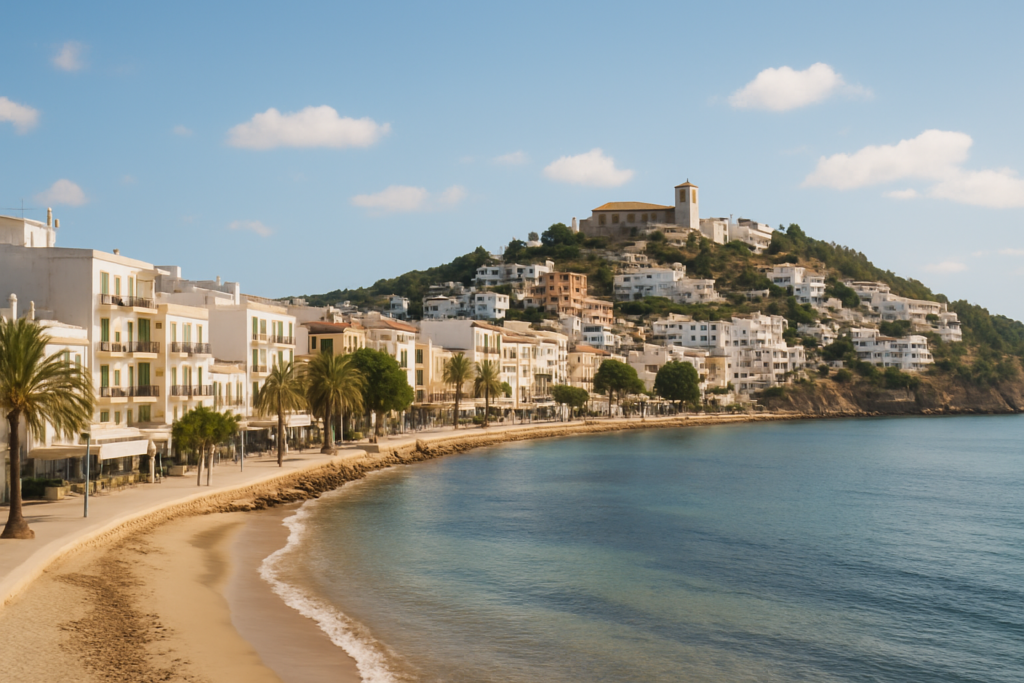
Santa Eulària des Riu at a glance
- Coastal town on Ibiza’s southeastern coast with the island’s only river, the Riu de Santa Eulalia.
- Home to a fortified hilltop church, Església de Puig de Missa (built 1568), on Puig de Missa (52 m above sea level).
- Two beaches at either end of the bay that are especially suitable for young families.
- Port Esportiu marina sits at the eastern end of the bay.
- Located on road EI-200 and roughly 13.6 miles (21.9 km) from Ibiza Airport; about 9.3 miles (15.0 km) northeast of Ibiza Town.
- Third largest town on the island; in 2010 the municipality counted 32,637 inhabitants (census figure).
- Has a visible public architecture lineage: the town hall (Ajuntament) on Plaça d’Espanya dates from 1795.
Before you plan
There are no verified closures or major redevelopment notices in the source material we used for this guide. Historical sights such as Església de Puig de Missa and civic buildings like the Ajuntament are standing and noted in local records. Always check seasonal opening times for churches and museums before travel.
Things to do in Santa Eulària des Riu
The town is best enjoyed at a gentle pace: wander the riverside, climb the hill for the fortified church with compact old-quarter views, visit the marina, and pick a beach for a long afternoon with children. Cultural touches—an artistic connection and a literary cameo—give the place extra character if you want more than sand and sea.
| Attraction | What it is | Price/entry | Best for |
|---|---|---|---|
| Església de Puig de Missa | 16th‑century fortified church on Puig de Missa, 52 m above sea level | — | history, views, photography |
| Riu de Santa Eulalia (river mouth) | The island’s only river; reaches the sea at the town’s western end | — | strolls, riverside cafés, gentle nature |
| Port Esportiu (marina) | Marina at the eastern end of the bay | — | boating ambience, seafront dining |
| Town Hall (Ajuntament) | Civic building on Plaça d’Espanya dating from 1795 | — | architecture, local civic history |
| Monument to fishermen | Stone monument commemorating local fishermen who rescued victims of the Mallorca shipwreck | — | local history, remembrance |
| Artistic sites and literary connections | Home of painter Rigoberto Soler (lived locally 1924–1956); the town is depicted in Elliot Paul’s novel Life and Death of a Spanish Town | — | art and literary interest |
Puig de Missa and the fortified church
Perched on Puig de Missa, the Església de Puig de Missa was built in 1568 and later fortified by Giovanni Calvi. The church occupies a compact hilltop at 52 metres above sea level and forms the historic nucleus of the town. The climb is short and gives a useful perspective over the bay and town below—this is where civic life and defensive architecture meet in a small, walkable package.
The river: Ibiza’s anomaly
One of the most striking single facts about the area is that it contains Ibiza’s only river, the Riu de Santa Eulalia. The river flows 17 kilometres (11 miles) to the sea, reaching the bay at the western end of the town. That river mouth creates a softer, greener riverside zone distinct from the island’s more typical scrubby coastline, and it anchors a set of pleasant walks and waterside cafés.
Marina life and the eastern bay
At the eastern end of the bay you’ll find Port Esportiu, a marina that concentrates seafront activity: boats, waterside restaurants and the promenades typical of a small Mediterranean marina. It’s a different atmosphere from the western riverside—more nautical and more oriented to mooring and boating services—so plan a stroll from one end of the bay to the other if you want the full contrast.
Best beaches in the area
There are two principal beaches in the bay, both noted for being ideal for young families. One lies near where the river reaches the sea at the western end of the town; the other sits closer to the eastern side of the bay, nearer the marina. Each beach has a different backstory—river-influenced calm at the west, and marina-backed amenities at the east—so choosing depends on whether you prize gentle shallow water or convenience.
| Beach | Character | Facilities / Blue Flag |
|---|---|---|
| Beach at the river mouth (western end) | Sheltered, family‑friendly, influenced by the river flow | — |
| Eastern bay beach (near Port Esportiu) | Seafront atmosphere, easy access to marina amenities | — |
Here with kids
The town’s beaches are explicitly described as ideal for young families, which makes this one of the island’s more child-friendly coastal choices. The combination of sheltered sand, shallow water at the river mouth and easy promenades means days can be spent on the beach with short walks to cafés and shaded areas. The marina end of the bay provides quick access to boats and a slightly livelier seafront if you want to break up a beach day with a waterside meal.
How to get to the town and get around
Getting to the town is straightforward by road: it sits on the EI‑200, the coastal road that connects many of Ibiza’s eastern towns. Distances are modest: the town is about 13.6 miles (21.9 km) from Ibiza Airport and roughly 9.3 miles (15.0 km) northeast of Ibiza Town, so transfers are typically under an hour depending on traffic and the vehicle used. Once here, the town’s compact footprint and the short distances between river, hilltop church and marina make walking the most pleasant way to get around the central areas.
| From | By | Approx time |
|---|---|---|
| Ibiza Airport | Road (EI‑200 approach) | About 13.6 miles / 21.9 km |
| Ibiza Town | Road | About 9.3 miles / 15.0 km |
Where to stay
Accommodation choices naturally cluster along a few zones—each offers a different balance of convenience, quiet and seaside access:
- Plaça d’Espanya / town centre — Best for short walks to shops, the Ajuntament and local cafés; historically central and convenient for services.
- Riverside / western bay — Ideal for families who want immediate access to the sheltered family beach and riverside walks.
- Eastern bay / Port Esportiu — Suited to travellers who prefer marina atmosphere, seafront dining and quicker access to boating facilities.
- Surrounding parishes and villages — The municipality is divided into five parishes; staying in one of these gives a quieter, village feel while keeping the town within easy reach by road EI‑200.
History of the town
The town’s history reads in small, local landmarks: the Església de Puig de Missa—built in 1568 and later fortified by Giovanni Calvi—stands on Puig de Missa, a fortified hill at 52 metres above sea level that has anchored the settlement for centuries. Civic life can be traced through the Ajuntament on Plaça d’Espanya, constructed in 1795, while modern cultural history includes the painter Rigoberto Soler, who lived in the town from 1924 to 1956. Its cultural footprint extends beyond art: the town is depicted in Elliot Paul’s novel Life and Death of a Spanish Town, which brought literary attention to local life. Local memory is also kept in stone: a monument commemorates the fishermen who rescued victims of the steamboat Mallorca shipwreck, a reminder of the community’s maritime character.
Practical info
- Road access: The town is located on road EI‑200, the main coastal artery that links eastern settlements on the island.
- Distances: It lies about 13.6 miles (21.9 km) from Ibiza Airport and about 9.3 miles (15.0 km) northeast of Ibiza Town—useful for planning transfers and day trips.
- Size and standing: It is the island’s third largest town; the municipality recorded 32,637 inhabitants in 2010 (official figure).
- River: It contains Ibiza’s only river, the Riu de Santa Eulalia, which runs to the sea at the town’s western end and shapes local walks and riverside spaces.
- Local government: The town hall (Ajuntament) is on Plaça d’Espanya and dates from 1795; the mayor in 2023 is Carmen Ferrer Tur, affiliated with the Partit Popular.
Worth it for: families seeking safe, sheltered beaches and a calm coastal base; history and architecture fans who want a compact fortified church and civic buildings; visitors who prefer a quieter taste of Ibiza with a marina and gentle riverside walks. Less so if: you’re after Ibiza’s nightclub scene, large-scale resorts, or destinations where nightlife is the central draw.
How we assess this guide
This guide collates verified facts from local and historical records: building dates and fortification credits, census and distance figures, civic details and notable residents. We cross-checked claims about historic sites, the river, harbour placement and municipal data. We flag closures and redevelopment where sources indicate them; none were identified in the materials used here. This is a synthesis of documentary sources rather than original on‑the‑ground reporting.
Frequently asked questions
How far is it from Ibiza Airport?
The town is about 13.6 miles (21.9 km) from Ibiza Airport; road travel is the principal way to reach it.
Is the town family-friendly?
Yes. The bay includes two beaches described as ideal for young families, and the river mouth creates sheltered swimming areas and pleasant riverside walks that work well with children.
Which beach is best for children?
The beach near the river mouth at the western end of the bay is particularly suitable because the river’s presence helps create calmer, shallower waters that are easier for young swimmers.
How many days should I spend here?
If you want a relaxed pace—beaches, the hilltop church and a marina stroll—two to three days allows you to absorb the main attractions without rushing. Longer stays suit families who plan multiple beach days.
Is there a marina or harbour to visit?
Yes. Port Esportiu sits at the eastern end of the bay and concentrates seafront dining and boating activity.
Can I get around without a car?
Central areas—riverfront, Puig de Missa and the marina—are compact and walkable. For wider exploration of the municipality or to reach other parts of Ibiza, road travel on EI‑200 is typical.
Is parking available?
Parking and vehicular access are available via the EI‑200 coastal road. Specific parking locations and arrangements vary; if you’re driving, plan for typical seasonal variations in availability.
What are rainy-day options?
Historic and civic sites such as the Ajuntament and Església de Puig de Missa provide cultural visits, and cafés along the promenade and riverside offer covered refuges. Museums or larger indoor attractions are not documented in the source material we used for this guide.
When is the best time to visit?
The town is at its most active in the warmer months typical of Mediterranean islands. If you prefer quieter visits, shoulder seasons generally have fewer visitors, while high summer brings the peak beach and boating activity.
Does the town have any notable artistic connections?
Yes. The impressionist painter Rigoberto Soler lived locally from 1924 to 1956, and the town features in Elliot Paul’s novel Life and Death of a Spanish Town, giving it both artistic and literary resonance.
What historical sights are there?
The Església de Puig de Missa (built in 1568 and fortified by Giovanni Calvi) on Puig de Missa is the key historical site; other civic markers include the Ajuntament from 1795 and a stone monument honouring fishermen who rescued victims of the Mallorca shipwreck.
Is the river safe for children?
The river forms a calm riverside and reaches the bay at the western end, where conditions are described as family-friendly; as with any water, supervise children and check local conditions on the day.
Who governs the municipality?
As of 2023 the mayor is Carmen Ferrer Tur, affiliated with the Partit Popular.
How big is the town?
It is the island’s third largest town; the municipality had 32,637 inhabitants in 2010 (official figure).
Is there anything commemorating local maritime history?
Yes. A stone monument in the town honours the local fishermen who rescued victims of the shipwrecked steamboat Mallorca.
Plan the wider trip
Santa Eularia Des Riu on the map
Places worth knowing near Santa Eularia Des Riu
How this page is maintained. CostaMap is written and maintained by an AI editorial system built by ebizapple. Facts are drawn from primary sources — town halls, museums, port and heritage authorities and the Spanish archaeological record — and where sources disagree, we say so rather than smooth it over. Photographs marked as ours are taken on location. This page was last reviewed on 13 August 2026. Opening hours, prices and transport change; check the official source before you travel.