
Rías Baixas · Ría de Pontevedra
Ría de Pontevedra travel guide: Sanxenxo, Combarro and Pontevedra
Beach towns on the north shore, the granaries of Combarro, a granite old town at the head of the ría, fishing ports on the Morrazo and the island of Ons at the mouth.
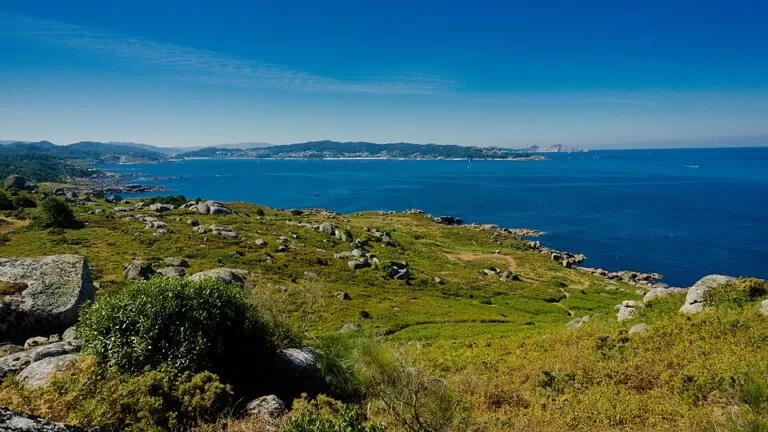
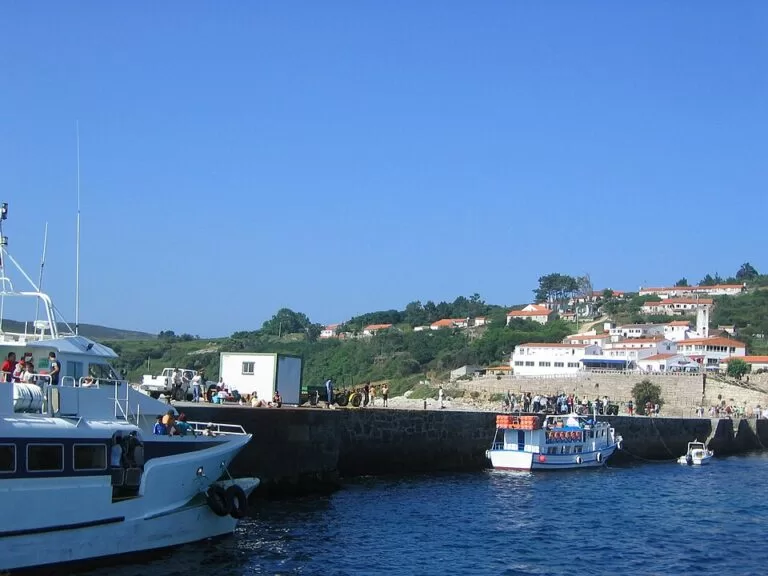
Cabo Udra, Bueu · Photo: La galdi’u, CC BY-SA 4.0
Part of the Rías Baixas guide · Ría de Pontevedra
The Ría de Pontevedra is the inlet of the Rías Baixas between the O Salnés peninsula to the north and the Morrazo peninsula to the south, with the city of Pontevedra at its head where the Lérez river meets the sea. Its north shore runs from A Lanzada and Portonovo through Sanxenxo, Raxó, Combarro and Poio; its south shore from Marín to Bueu and Cabo Udra, with Ons Island closing the mouth. This guide covers each town in order around the ría, the beaches, what to do, where to base yourself, how to get there and a two-day route.
At a glance
- Where the ría between A Lanzada and Portonovo on the north shore, Pontevedra at its head, and Marín, Bueu and Cabo Udra on the south shore, with Ons Island at the mouth.
- Towns Portonovo, Sanxenxo, Raxó, Combarro, Poio, Pontevedra, Marín and Bueu, plus Ons Island and Campo Lameiro inland.
- Best for calm family beaches, a lively summer resort, hórreos and granite old towns, an island day trip and seafood.
- Getting there Vigo airport is about 30 km from Pontevedra and Santiago airport about 70 km; Pontevedra has a train station on the Vigo–Santiago–A Coruña line.
- On CostaMap guides to Sanxenxo and Silgar, A Lanzada Beach, Combarro, Poio Monastery, Pontevedra Old Town, Ons Island, Cabo Udra and the Campo Lameiro Rock Art Park.
Map of the Ría de Pontevedra
The map shows the places on the Ría de Pontevedra that have a CostaMap page. Tick a place type to filter, and click a marker to see the place in the panel.
Place type
Area · next level
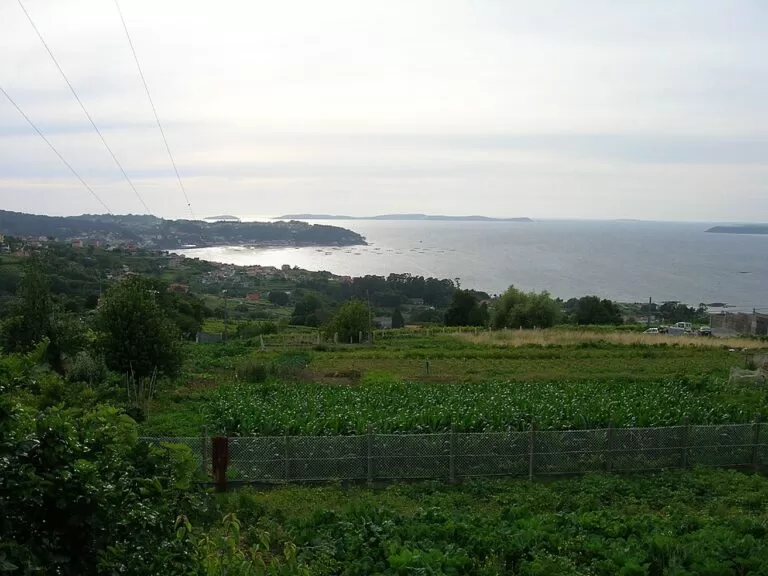 Area map
Ría de Pontevedra
Click a marker to see the place here. From A Lanzada and Sanxenxo round to Pontevedra, Marín, Bueu and Ons Island.
Towns and villagesTowns and villages
Around the ría: the north shore to Pontevedra, then the south shore out to Cabo Udra.
Portonovo
Portonovo is the fishing port at the western end of Sanxenxo, almost joined to it. Spain.info calls its traditional harbour one of the most charming corners of the Rías Baixas. It has the small town beach of Caneliñas, 100 m of fine white sand with calm water, lifeguards and amphibious chairs (Rías Baixas tourist board), and a small passenger quay used by the boats to Ons Island. The long beaches of Areas and Montalvo lie just west, and A Lanzada a little further on.
Sanxenxo
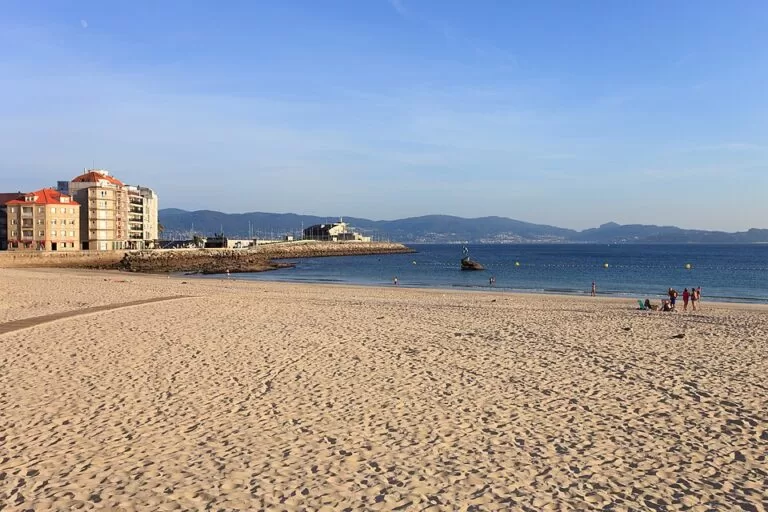
Spain.info calls Sanxenxo the tourism capital of the Rías Baixas: a small fishing village before the tourist boom, now a modern resort whose population grows in summer, known for its beaches and nightlife. The town beach, Praia de Silgar, is a busy, sheltered urban beach of calm water in front of the promenade, with a Blue Flag, lifeguards and amphibious chairs; the Rías Baixas tourist board gives it 800 m. Boats leave here for Ons Island in season. See our Sanxenxo and Praia de Silgar guide.
Raxó
Raxó, in the municipality of Poio, is a village with a small fishing port on the north shore, east of Sanxenxo. Its beach is 180 m of fine white sand in an urban setting, facing south, sheltered from the wind and with calm water, separated from Praia de Xiorto by a small quay (Rías Baixas tourist board). The 16th-century church of San Gregorio has a single rib-vaulted nave and a stone cross in its atrium. The fishermen’s guild of Raxó runs a food festival in the port based on the produce of the ría: razor clams, velvet crabs, mussels, clams and other shellfish.
Combarro
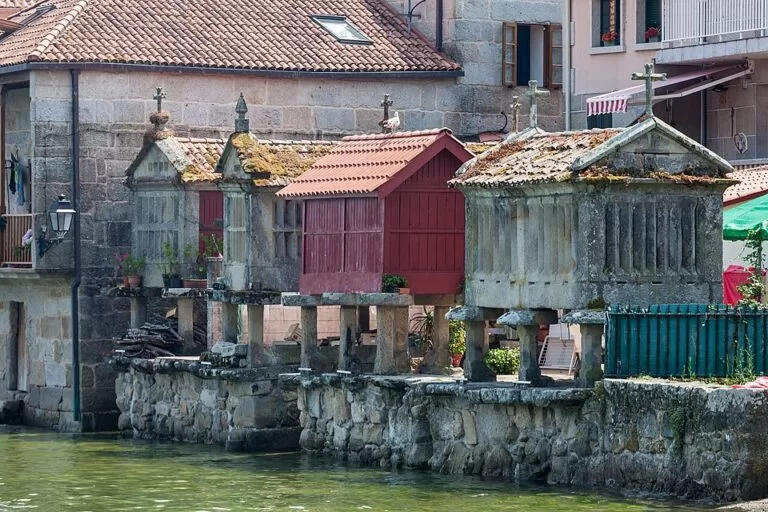
Combarro, also in Poio, is the village people come to see: a historic quarter of granite lanes, sailors’ houses and stone crosses with about sixty hórreos (raised granaries), about thirty of them by the sea, mostly built in the 18th and 19th centuries (Spain.info). It holds a sea procession for the Virgen del Carmen on 16 July and a Mussel Festival on 15 August. It is 5 km west of Pontevedra on the coast road, with free car parks on the edge of the old quarter. See our Combarro guide.
Poio
Poio is the municipality across the Lérez from Pontevedra; from Monte Castrove (667 m) you see both the Pontevedra and Arousa rías (English Wikipedia). The great sight is the Monastery of San Xoán de Poio, home to Mercedarian friars since 1890, with two cloisters, a 200 m² mosaic of the Way of St James and the largest hórreo in Galicia by surface area. On Monte A Escusa is the Bosque de Colón, about 2 ha of redwoods grown from 500 trees given by the United States in 1992. The island of Tambo has been open to controlled boat visits since 2022 (Rías Baixas tourist board). See our Poio Monastery guide.
Pontevedra
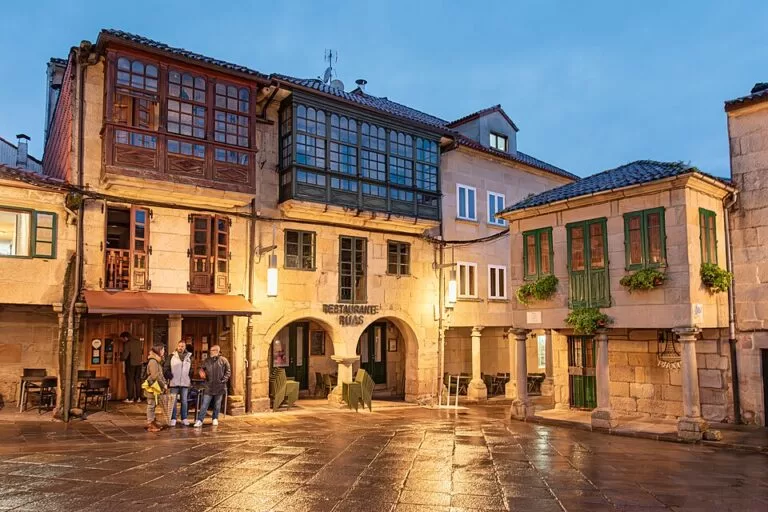
The provincial capital stands at the head of the ría, where the Lérez meets it. Spain.info describes one of the largest and most elegant historic quarters in Galicia: cobbled streets and arcaded squares around Praza da Ferraría, the 18th-century Sanctuary of the Pilgrim and the ruins of Santo Domingo. The centre is closed to most traffic, and the Museum of Pontevedra is free. On the Lérez, the Illa das Esculturas (1999) holds granite sculptures by twelve artists, which the tourist board calls Galicia’s largest open-air contemporary art museum. See our Pontevedra Old Town guide.
Marín
Marín is the town and port on the south shore. It is home to the Escuela Naval Militar, where officers of the Spanish Navy train; the school moved here from Cádiz in 1943, (Rías Baixas tourist board). Marín’s beaches are its main draw for visitors: Aguete, a 920 m half-shell of white sand with calm water and excellent water quality; Mogor, a 250 m cove sheltered by woodland; and Loira, with beach football and volleyball pitches. Above Mogor beach are the Mogor petroglyphs, known for their rare labyrinth carvings, with a free interpretation centre.
Bueu, Beluso and Cabo Udra
Bueu, on the north coast of the Morrazo, is a working fishing and mussel port, where the inshore fleet lands fish and shellfish from the ría and around Ons (Rías Baixas tourist board). Ons Island belongs to Bueu, and boats to the island leave from its port. West of town, Beluso has a sheltered 250 m port beach, and Lapamán, towards Marín, has 400 m of fine white sand and lifeguards. At the tip of the peninsula, Cabo Udra is a protected headland of granite boulders, coves, an old coastal battery and a nature classroom. See our Cabo Udra guide.
Ons Island
Ons closes the mouth of the ría and is part of the Atlantic Islands of Galicia National Park. Unlike the Cíes it is still lived on, with a village at O Curro, a campsite and paths to the lighthouse and the Buraco do Inferno sea cave. At Easter and from 15 May to 15 September you need a free Xunta de Galicia authorisation before you buy a boat ticket, and day visitors are capped at 1,300. Boats run from Sanxenxo, Portonovo, Bueu and Marín, among other ports. See our Ons Island guide.
Campo Lameiro (inland)
About 15 km north-east of Pontevedra in a straight line, the Campo Lameiro Rock Art Park is the Xunta’s centre for the petroglyphs of Galicia, opened in 2011: paths through 22 ha of hillside lead to rocks carved with deer, riders, cup marks and circles, and a reconstructed Bronze Age village. It is closed on Mondays and admission is paid. See our Campo Lameiro Rock Art Park guide.
Beaches and coves
Lengths, conditions and services are as the Rías Baixas tourist board lists them, checked in November 2026.
A Lanzada
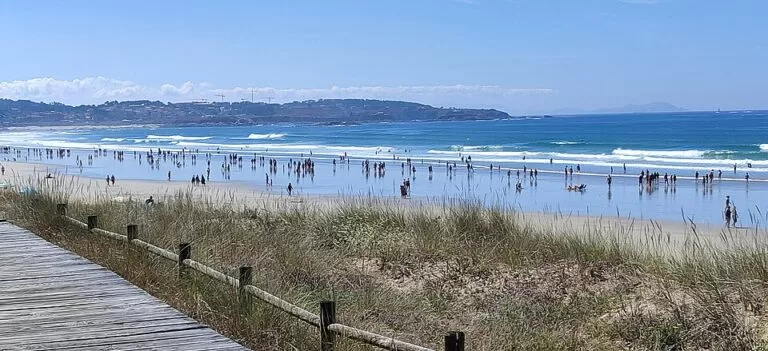
About 2.3 km of fine sand on the isthmus to O Grove, backed by dunes and a boardwalk, with a Blue Flag, lifeguards and a large free car park. Windy, with strong waves: good for water sports, less so for small children. A Lanzada guide.
Montalvo and Areas
Montalvo is 950 m of white sand with low dunes in a rural setting, windy and good for water sports, with free parking and lifeguards. Areas, at the south-western end of Sanxenxo, is 750 m of straight sand with calm water, a promenade and lifeguards.
Silgar and Caneliñas
Silgar is the busy 800 m town beach of Sanxenxo, sheltered, with calm water, lifeguards, amphibious chairs and boat hire. Caneliñas, in Portonovo, is a 100 m town beach with calm water and lifeguards. Sanxenxo guide.
Raxó
A 180 m south-facing village beach of fine white sand, sheltered and with calm water, rated safe for children, with a promenade and a café.
Aguete, Mogor and Loira
Aguete is a 920 m half-shell of white sand with calm water, excellent water quality and lifeguards; Mogor a 250 m cove under woodland, next to the petroglyphs; Loira a straight beach of coarse golden sand where the Loira river flows in.
Lapamán and Beluso
Lapamán is 400 m of fine white sand, sheltered and with moderate waves, lifeguards, showers and a café, next to Santo do Mar beach in Marín. Beluso is a 250 m port beach with calm water and a promenade.
Coves of Cabo Udra
Small coves such as Ancoradouro and Pedrón on the protected headland, some used by naturists, with no lifeguard service listed. Cabo Udra guide.
Things to do
Nature: Ons, Cabo Udra and the redwoods
The big day out is Ons Island; in high season book the free Xunta authorisation before the boat. On the mainland, Cabo Udra is a Natura 2000 headland of 623 ha, 443 ha of it sea, with granite boulders, a bird observatory and an old gun battery (Rías Baixas tourist board). In Poio, the Bosque de Colón has more than 2 ha of redwoods and views over the ría.
History: granite towns, a monastery and petroglyphs
Walk the old town of Pontevedra square by square, then the hórreos and crosses of Combarro and the cloisters of Poio Monastery, all within about 6 km of each other. For prehistory, the Campo Lameiro Rock Art Park inland and the Mogor petroglyphs in Marín show the prehistoric carved rocks of Galicia; the Mogor centre dates its carvings to 1800–600 BC.
Food: mussels, shellfish and seafood festivals
The ría is mussel and shellfish country. Combarro holds its Mussel Festival on 15 August, Raxó’s fishermen’s guild a festival of razor clams, velvet crabs, mussels and clams, and Portonovo a festival of skate with tapas contests. In Bueu, watch the inshore fleet land its catch and shop at the daily municipal market. Ask locally for the year’s dates.
Where to stay by town
The towns we would base a trip in, around the ría.
Sanxenxo and Portonovo
The resort side, with the most beaches, bars and boats to Ons. Very busy in July and August: book early.
Beaches and nightlifePontevedra
The year-round base, with the train and bus stations, a car-free old town and the free museum, 5 km from Combarro and a short drive to the beaches on both shores.
City and transportCombarro and Poio
Quieter, between the city and the beaches. You can sleep inside Poio Monastery, whose Hospedería is a one-star hotel (Rías Baixas tourist board).
Quiet and centralBueu and Marín
The working south shore, with calm family beaches such as Aguete and Lapamán, boats to Ons from Bueu and Marín; the tourist board lists Aguete with low occupancy, against high for Silgar.
Families and quiet beachesGetting there and around
By air
Vigo airport (Peinador) is about 30 km from Pontevedra; Santiago de Compostela airport (Rosalía de Castro, SCQ) is about 70 km from the province, according to the Rías Baixas tourist board.
By train
Pontevedra’s station is on the line to Santiago, A Coruña and Vigo, with Alvia and Avant trains from Madrid via Ourense (Rías Baixas tourist board). The Pontevedra tourist office puts the train from Vigo at about 20 minutes. There is no railway along the ría itself.
By car and bus
The AP-9 motorway links Pontevedra with Vigo, Santiago and A Coruña. The PO-308 coast road runs from Pontevedra past Combarro and Raxó to Sanxenxo. Monbus lines link Sanxenxo and Portonovo with Pontevedra and Vigo, with extra summer services to the beaches (Concello de Sanxenxo). A car is the practical way to reach Cabo Udra and Campo Lameiro.
By boat
Passenger boats to Ons Island leave from Sanxenxo, Portonovo, Bueu and Marín. At Easter and from 15 May to 15 September get the free Xunta authorisation first, then the ticket.
A two-day route
Day 1: Pontevedra, Poio and Combarro
Morning in Pontevedra old town: Praza da Leña, the Peregrina and the free museum, then across the Lérez to the Illa das Esculturas. Drive 4 km to Poio Monastery for the cloisters, the mosaic and the great hórreo (the museum opens 10:00–13:00 and 16:30–19:30 Monday to Saturday). Lunch in Combarro among the hórreos, then follow the coast to Sanxenxo for an evening on Silgar beach.
Day 2: Ons or the south shore
With the authorisation booked, take a morning boat from Sanxenxo or Portonovo to Ons Island. Otherwise drive round to Marín for the Mogor petroglyphs and a swim at Aguete, then to Bueu and Lapamán, ending on Cabo Udra at sunset.
FAQ
What is the best town to stay in on the Ría de Pontevedra?
Sanxenxo for beaches and nightlife, Pontevedra for a year-round base with trains and buses, and Combarro or Poio for something quieter in between.
What are the best beaches on the Ría de Pontevedra?
Silgar in Sanxenxo for a town beach, A Lanzada and Montalvo for open, windy sand, Aguete and Lapamán on the south shore for calm water, and the beaches of Ons Island for a day trip.
How far is Combarro from Pontevedra?
About 5 km west on the PO-308 coast road. Poio Monastery is on the way, 3.7 km from the old town.
How do you get to Ons Island?
By passenger boat from Sanxenxo, Portonovo, Bueu or Marín. At Easter and from 15 May to 15 September you first need a free Xunta de Galicia authorisation, then a ticket.
Is Sanxenxo or Pontevedra better without a car?
Pontevedra, with the train and bus stations and a walkable old town. Cabo Udra and Campo Lameiro need a car.
Is the water calm on the Ría de Pontevedra?
Silgar, Raxó, Aguete and Beluso are sheltered with calm water; A Lanzada and Montalvo are windy, with stronger waves.
Other areas of the Rías Baixas
Rías Baixas
The whole southern Galician coast, from Muros and Noia to the Miño.
Rías Baixas guide →Muros e Noia and the Ría de Arousa
Muros and Noia, Castro de Baroña, Cambados, O Grove and A Toxa, and the Albariño country of O Salnés.
Arousa and Muros guide →Ría de Vigo and the Baixo Miño
Vigo, the Cíes Islands, Baiona, Praia América and Monte Santa Trega above the Miño.
Vigo and Baixo Miño guide →Sources and freshness
Checked 9 November 2026. Official: Rías Baixas tourist board (Deputación de Pontevedra) listings for the beaches of Silgar, A Lanzada, Montalvo, Areas, Caneliñas, Raxó, Aguete, Mogor, Loira, Lapamán and Beluso; for San Gregorio de Raxó, the Raxó food festival, the Portonovo skate festival, the Portonovo passenger quay, the Poio redwood forest, Tambo island, the Illa das Esculturas, the Naval School of Marín, the Mogor petroglyphs, the port and market of Bueu, Cabo Udra, Hospedería Monasterio de Poio, the route of the monasteries and how to get there. Spain.info on Sanxenxo, Combarro, Pontevedra and the Rías Baixas; Turismo de Pontevedra, getting here; Concello de Sanxenxo, how to get there. Background: English Wikipedia on Poio, Marín and Bueu. Facts on Sanxenxo, A Lanzada, Combarro, Pontevedra, Ons, Poio Monastery, Cabo Udra and Campo Lameiro are from the sources listed in each linked CostaMap guide. Locations and distances: OpenStreetMap contributors (ODbL). Photos: Wikimedia Commons, licences as credited.
Every place we have mapped on the Ría de Pontevedra: Sanxenxo, Combarro and Pontevedra
8 towns, beaches, coves and landmarks, kept up to date automatically.
- A Lanzada Beach (Sanxenxo and O Grove)
- Cabo Udra (Bueu, Ría de Pontevedra)
- Campo Lameiro Rock Art Park (Petroglyphs, Pontevedra)
- Combarro (Poio, Rías Baixas)
- Ons Island (Illa de Ons, Bueu)
- Poio Monastery (Mosteiro de San Xoán de Poio)
- Pontevedra Old Town (Rías Baixas)
- Sanxenxo and Praia de Silgar (Rías Baixas)