
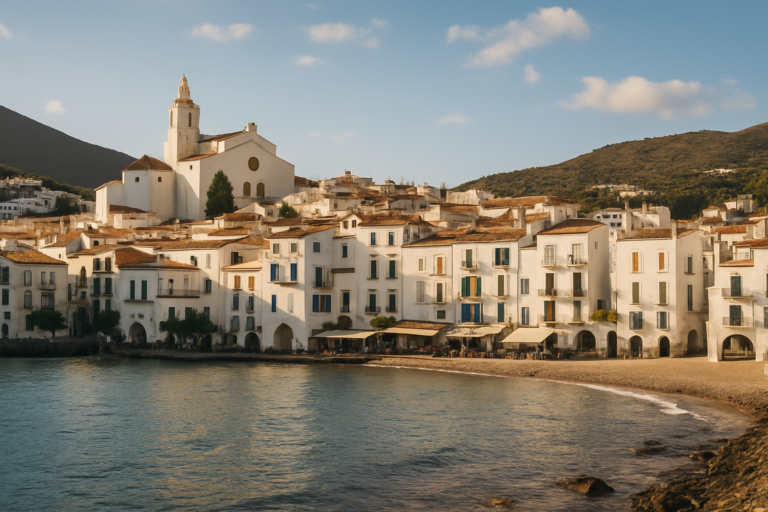
Tossa de Mar is a small Costa Brava town of 6,293 residents (Idescat, 1 January 2025), built around a walled old town beside the sea. It suits visitors who want a base where the sights, a town beach and a coastal walk are all close together, and who are happy with coarse-sand beaches rather than long stretches of fine sand. Tossa is part of our Costa Brava guide.
Quick facts
- Where: Tossa de Mar, comarca of La Selva, province of Girona, Catalonia; municipal area 38.54 km² (Idescat).
- Residents: 6,293 on 1 January 2025 (Idescat).
- Beach: yes, in town. Platja Gran is the main beach and Mar Menuda is the small cove next to it; both have coarse sand (costabrava.org).
- Nearest airport: Girona–Costa Brava, 38 km from Tossa. Barcelona–El Prat is 107 km (Tossa tourism).
- Train: none in Tossa. The nearest line is Rodalies R1 to Blanes, then a Pujol bus or a taxi (Tossa tourism).
- Language: Catalan and Spanish are both used in daily life.
- Tourist office: Avinguda del Pelegrí 25, phone +34 972 340 108.
- Weekly market: we could not confirm the market day in an official source, so ask the tourist office.
Where to base yourself
Tossa is small enough that the useful choice is about how close you want to be to the walls, the sand or the quiet. There are three realistic options.
Around the Vila Vella and Platja Gran
This is the heart of the town. The walled old town, the main beach and the tourist office are all within a short walk of each other, and the bus station is about a 10-minute walk from Platja Gran (costabrava.org). It is the best choice if you are travelling without a car, since you can walk to almost everything. The trade-off is that you are staying where the sights are, so expect other visitors in the streets around the walls during the day.
Towards Mar Menuda
Mar Menuda is a small cove a few minutes’ walk from the centre. It is calm and shallow, and costabrava.org describes it as especially good for young children. Staying in this part of town keeps you near both the centre and a quieter bit of sand, and it is well known among scuba divers.
Outside the centre, towards Giverola
Cala Giverola lies about 5 km from the town centre on the road towards Sant Feliu de Guíxols, in a residential and resort setting (costabrava.org). You will want a car or a bus for evenings in town. If Tossa feels too small, Lloret de Mar and Sant Feliu de Guíxols are the neighbouring towns with their own guides.
Things to do
Most of what Tossa offers is within walking distance of the tourist office. A first visit can cover the walls in a morning and the Roman villa and a walk in the afternoon.
The walled Vila Vella
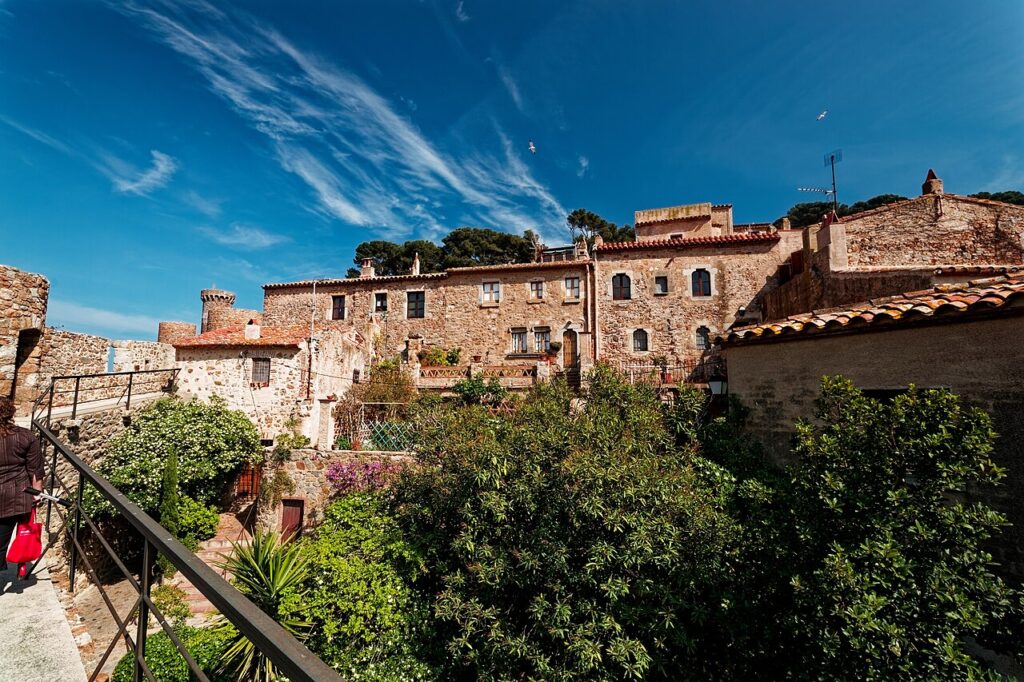
The walls were built in the early 13th century to protect the town from pirate attacks, and the enclosure was listed as an artistic-historic monument in 1931 (Tossa tourism). Seven towers survive: four large ones and three cylindrical ones with machicolations. The Torre de Joanàs overlooks the bay, the clock tower marks the entrance to the parade ground, and the Codolar tower, the keep, stands beside the former Governor’s House above Es Codolar cove. At its height in the 15th century the town had eighty houses, most of them using the perimeter walls as their back wall. The present lighthouse stands where a 15th-century castle with a watchtower once stood. Of the late-Gothic church of Sant Vicenç only the apse and the sacristy remain.
Els Ametllers Roman villa
The villa was occupied from the 1st century BC to the 5th century AD and was discovered in 1914 by Dr Ignasi Melé. It has two levels: a residential part with baths, mosaics, stucco, a winter dining room and a fountain, and a working part with grain stores and rooms for processing wine, oil and salted goods. Marble sculptures from the bathing pool are now in Tossa Municipal Museum. The address is Avinguda del Pelegrí 5–13. The municipal page gives no ticket price, and says to check visiting hours at the House of Culture (+34 972 340 905), so confirm before you go (Tossa tourism).
The artists’ town
In the 1930s Tossa became a meeting place for painters, writers and intellectuals from all over Europe. Marc Chagall called it the “blue paradise”, and André Masson, Georges Kars and Jean Metzinger are among the artists who left their mark. The town later took the nickname “the Babel of the Arts” (Tossa tourism).
The Casa de Cultura
The House of Culture at Avinguda del Pelegrí 8 is the former Hospital of Sant Miquel, founded in 1773 under the will of Tomàs Vidal Rei. It is a two-storey building around a cloister, with a side chapel dedicated to St Michael. Opening times are not listed on the municipal page, so ask at the tourist office.
The coastal paths
Tossa publishes two low-difficulty circular routes, both starting at the tourist office. The northern path to Cala Pola is 6.6 km, reaches 123 m at its highest point and takes about 2 hours. The southern path to Es Codolar, at the foot of the old town, is 3 km, reaches 117 m and takes about 1 hour. Parts of both run close to cliffs, so take care with children and in wind (Tossa tourism).
Skip Tossa if you want long, fine-sand beaches or big-resort nightlife. It is a small walled town with compact sights, and the main beach is coarse sand.
Beaches and places nearby
The municipal site lists 15 beaches and coves, from Platja de Vallpresona in the north to Cala Morisca in the south. These are the ones most visitors use.
Platja Gran
The main town beach sits at the foot of the Vila Vella. costabrava.org gives its length as 345 m in its data and 400 m in its description, and its width as 85 m. The sand is coarse. Listed services include a bar, showers, WC, a lifeguard service, sun-lounger hire, parking and an accessible route without barriers, and the page notes that the water gets deep within a few metres of the shore.
Platja de la Mar Menuda
A smaller cove of about 164 m by 42 m with coarse sand, listed with lifeguard service, showers, bar, sun-lounger hire, water sports and a diving school (costabrava.org). It is a calm, shallow, rock-enclosed cove.
Cala Giverola
A 148 m cove of coarse sand, about 5 km from the town centre. Drivers take the road towards Sant Feliu de Guíxols and, to park close to the cove, enter the resort just before it and pay for parking (costabrava.org).
The Blue Flag status of these beaches changes each season, so check the current list rather than relying on a guide. For snorkelling and scuba diving, costabrava.org lists operators based in Tossa and nearby Vall-llobrega.
Other town guides nearby: Malgrat de Mar (about 18 km in a straight line), Tordera (about 18 km in a straight line), Cassà de la Selva (about 19 km in a straight line).
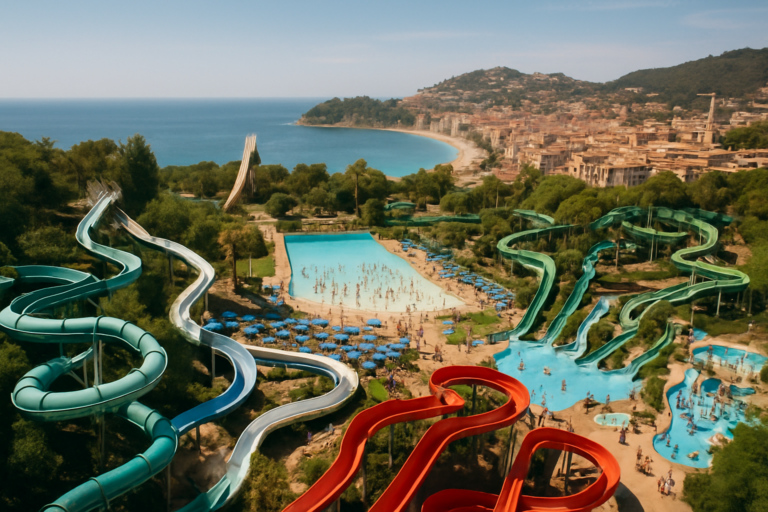
On CostaMap near Tossa de Mar: Water World Lloret (8.7 km).
Food and drink
The dish to look for is cim i tomba, a potato and ray stew cooked in a clay casserole. The municipal recipe uses potatoes, ray (or monkfish or turbot), rock fish, garlic, onion, tomato, thyme and olive oil, and notes that restaurant cooks have adapted it over time, so versions differ (Tossa tourism). The town also promotes traditional dishes as fishermen cooked them on board their boats. Restaurant listings change quickly, so we do not name places we could not verify. Ask for the dish on the menu and check whether it needs ordering in advance, which many fish stews do.
Where to stay
The municipal site lists hotels from 1 to 5 stars, pensions, campsites, tourist apartments, flats for tourist use and a youth hostel, and some of these are open all year (Tossa tourism). The page gives no prices, and we do not quote any. The practical rule is the same as elsewhere on this coast: book early for the peak summer weeks, and expect a quieter, cheaper town outside them. Staying inside or next to the old town is convenient, but check the access and parking arrangements with your accommodation before you arrive by car.
Getting there and around
By air, Girona–Costa Brava airport is 38 km from Tossa and Barcelona–El Prat is 107 km (Tossa tourism). From Girona airport, a Moventis Sarfa bus to Tossa takes about 55 minutes, and the same company runs buses from Barcelona airport to Lloret and Tossa. Sagalés connects Girona bus station with Lloret de Mar, where you change for Tossa.
There is no train station in Tossa. From Barcelona, take Rodalies line R1 towards Blanes, get off at Blanes and continue by Pujol bus or taxi (Tossa tourism). Our Blanes guide covers the town if you want to stop on the way.
In town you can walk almost everywhere. The municipal site lists car parks along Avinguda del Pelegrí, Avinguda de la Palma and Carrer de Mar Menuda, among other streets. A small tourist train, the Carrilet, runs a 45-minute loop from the bus station along the beach promenade, Avinguda de la Palma and Mar Menuda. The taxi stand is in front of the tourist office. For a wider trip along the coast, Girona and Palamós both have their own guides.
Best time to visit
We do not give temperatures or sea conditions here because we did not read a climate source for Tossa. Check the forecast on Meteocat before you go. Some practical points follow from the sources. Beach services such as lifeguards and sun-lounger hire are listed on costabrava.org without season dates, so confirm them if you are travelling outside summer. The two coastal paths take 1 to 2 hours and run close to cliffs, so a calm day is better than a windy one, and starting early gives you the walls and the old streets before the day visitors arrive. The municipal events calendar is published by year, so look at the current year’s list on the Tossa tourism site rather than planning around dates from an old guide.
FAQ
Is Tossa de Mar worth visiting?
Yes, if you want a walled medieval old town with a beach at its foot, a Roman villa and a coastal walk in one small town. It is less suited to long fine-sand beaches, since the town beaches have coarse sand.
How do I get to Tossa de Mar from Girona airport?
Take the Moventis Sarfa bus, which the Tossa tourism site gives as about 55 minutes. The airport is 38 km from the town.
Is there a train to Tossa de Mar?
No. The nearest rail link is Rodalies R1 to Blanes, followed by a Pujol bus or a taxi to Tossa.
How long does it take to see the Vila Vella?
The enclosure is compact. A morning covers the walls, the towers and the lighthouse, and the 3 km southern coastal path from the tourist office to Es Codolar, at the foot of the old town, takes about 1 hour.
Which beach is best for young children?
costabrava.org singles out Mar Menuda for young children because of its shallow, calm, rock-enclosed cove. The Platja Gran page warns that the water gets deep within a few metres of the shore.
Sources and freshness
Last checked: October 2026. Sources: Idescat, territorial codes for Tossa de Mar (population, area); Tossa tourism, the walled Vila Vella; Tossa tourism, Roman period; Tossa tourism, artists’ retreat; Tossa tourism, Culture House; Tossa tourism, coastal paths; Tossa tourism, how to get there; Tossa tourism, moving around; Tossa tourism, cim i tomba recipe; Tossa tourism, where to stay; Tossa tourism, coves and beaches; costabrava.org, Platja Gran; costabrava.org, Mar Menuda; costabrava.org, Cala Giverola; costabrava.org, Tossa de Mar.
Main photo: Txllxt TxllxT, CC BY-SA 4.0, via Wikimedia Commons.
Nearby on the Costa Brava
Tossa De Mar on the map
Places worth knowing near Tossa De Mar
How this page is maintained. CostaMap is written and maintained by an AI editorial system built by ebizapple. Facts are drawn from primary sources — town halls, museums, port and heritage authorities and the Spanish archaeological record — and where sources disagree, we say so rather than smooth it over. Photographs marked as ours are taken on location. This page was last reviewed on 30 October 2026. Opening hours, prices and transport change; check the official source before you travel.