
Baelo Claudia (Bolonia, Tarifa)
Historic siteBaelo Claudia is the Roman town on the beach at Bolonia, in the municipality of Tarifa on the Costa de la Luz. You reach it on the CA-8202 road into Bolonia, park by the visitor centre, and walk from a modern museum straight into a forum, a basilica, temples, a theatre and the vats where the town made salted fish and garum. The Andalusia tourism board lists entry as free (checked November 2026) and the site is closed on Mondays. It suits anyone with a couple of hours and an interest in Rome; skip it on a hot summer midday, as there is very little shade among the ruins.
Quick facts
- Names: Baelo Claudia; officially the Conjunto Arqueológico de Baelo Claudia. The beach and hamlet are Bolonia; OpenStreetMap places the site in El Lentiscal.
- Where: Ensenada de Bolonia s/n, 11380 Tarifa (Cádiz), at the north-west end of Bolonia beach.
- Coordinates: 36.0896, -5.7745.
- Founded: at the end of the 2nd century BC; most public buildings date from the reign of Claudius, who gave the town the rank of municipium.
- Abandoned: hit by an earthquake in the 3rd century AD; a small population hung on until the early 7th century.
- Protection: declared a national historic monument; a Bien de Interés Cultural since 1925.
- Entry: listed as free by the Andalusia tourism board (checked November 2026). English Wikipedia notes free entry for EU/EEA citizens with ID, so carry yours.
- Phone: +34 956 106 793.
Access and parking
By car: the site lies on the CA-8202, the local road into Bolonia (OpenStreetMap). Tarifa town is about 17 km to the south-east in a straight line; English Wikipedia gives 22 km from Tarifa, which matches the drive.
Parking: OpenStreetMap marks a supervised, paid surface car park on dirt next to the visitor centre, about 250 m east of the forum, and another paid car park about 500 m away near the beach. The Andalusia tourism board lists parking as one of the site’s facilities. In summer the Bolonia car parks fill with beach traffic, so arrive early.
Without a car: the nearest bus stop on OpenStreetMap is “Playa de Bolonia (El Lentiscal)”, run by the Tarifa town council, about 700 m east of the ruins. We could not confirm its timetable; check with Tarifa’s tourist office before relying on it.
What to expect
The Andalusia tourism board calls Baelo Claudia a Roman “city-factory” in a surprising state of preservation. Its wealth came from salted and preserved fish and from garum, a fish sauce exported across the empire. Excavations started in 1917. The town was laid out to a single plan, with the monumental centre built in one go on an axis running inland from the shore.
The visit starts in the visitor centre and museum, open since 2007 and designed by the architect Guillermo Vázquez Consuegra. From there a path leads into the town. According to English Wikipedia you can see:
- The walls, with more than forty towers, and gates towards Gades (Cádiz) and Carteia.
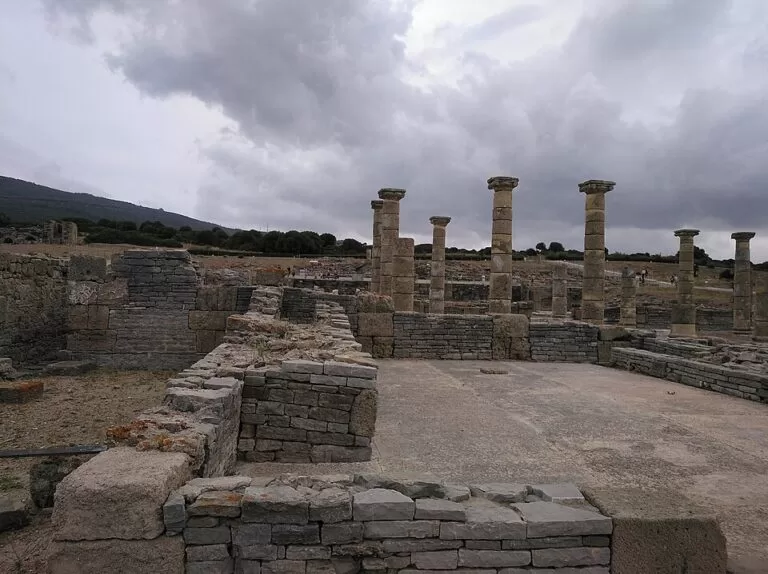
- The forum, still paved with its original slabs, with the curia and municipal archive around it.
- The basilica, the law court, 19.5 by 35.5 m, once presided over by a statue of Trajan more than 3 m tall.
- Four temples: three for Jupiter, Juno and Minerva, and one for the Egyptian goddess Isis.
- The theatre, the largest building, for up to 2,000 people, partly restored.
- The market (macellum) with 14 shops, the baths, four aqueducts and the industrial quarter with its fish-salting vats.
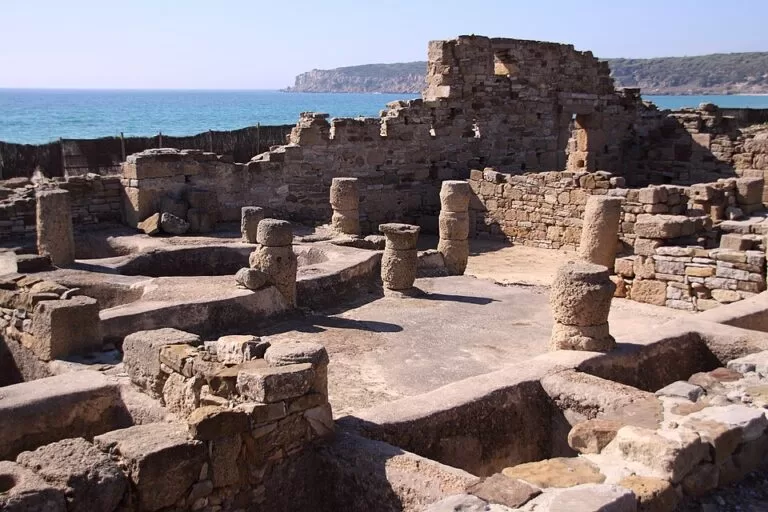
The site sits inside the Strait (Estrecho) natural park, and on a clear day you can see the coast of Morocco across the water. Excavations by the University of Cádiz have found a copy of Polykleitos’s Doryphoros, the only one known in Hispania (Wikipedia).
Prices and opening
From the Andalusia tourism board listing, checked November 2026. Closed every Monday.
- 21 September – 20 March: Tuesday to Saturday 09:00–18:00; Sundays and public holidays 09:00–15:00.
- 21 March – 20 June: Tuesday to Saturday 09:00–21:00; Sundays and public holidays 09:00–15:00.
- 21 June – 20 September: Tuesday to Sunday and public holidays 09:00–15:00.
- Entry: listed as free. Bring ID in case you are asked for it.
The official museums website of the Junta de Andalucía could not be reached from our research setup, so confirm holiday closures by phone (+34 956 106 793).
Accessibility and safety
The tourism board lists the site as accessible for people with disabilities and as having services for them; the visitor centre has toilets and a drinking-water fountain close by (OpenStreetMap). The ruins themselves are a large open area with uneven ground and almost no shade. In summer the morning-only hours help, but bring a hat and water. The wind at Bolonia can be strong.
Best time to visit
Spring is the best season: the long 09:00–21:00 opening from late March to late June lets you go in the late afternoon light. In summer the site closes at 15:00, so go at 09:00 and spend the afternoon on the beach. Allow about two hours for the museum and the ruins together. Mondays are closed all year.
Nearby alternatives
- Playa de Bolonia, 1.3 km away: the long beach right below the ruins, with its big dune.
- Tarifa, 17.3 km away: the windsurf town at Spain’s southern tip, with its castle and ferries to Tangier.
- Barbate, 17.5 km away: tuna-fishing port on the coast to the north-west.
- Vejer de la Frontera, 24.9 km away: white hill town above the coast.
- Cabo de Trafalgar, 25.6 km away: the lighthouse headland off which the 1805 battle was fought.
Distances are in a straight line from the ruins.
FAQ
Do you need tickets for Baelo Claudia?
The Andalusia tourism board lists entry as free (checked November 2026). You do not need to book for an individual visit; bring ID, as EU citizens are admitted free on showing it.
Is Baelo Claudia open on Mondays?
No. The site is closed every Monday. From Tuesday it opens at 09:00, and closing time depends on the season.
Is there parking at Baelo Claudia?
Yes. A paid, supervised car park sits next to the visitor centre, and more paid parking lies towards the beach. In summer these fill early.
How do I get to Baelo Claudia?
By car from Tarifa, about 22 km by road according to Wikipedia; follow the signs for Bolonia and the CA-8202 into the hamlet, where the site is signed by the visitor centre. A Tarifa council bus stop lies about 700 m away.
How long do you need at Baelo Claudia?
About two hours covers the museum and a walk round the forum, temples, theatre and fish-salting factory.
Sources and freshness
Checked 6 November 2026 · 4 sources Show
Checked 6 November 2026. Official: Andalusia tourism board listing for the Conjunto Arqueológico de Baelo Claudia (history, hours, entry, address, phone, facilities). The Junta de Andalucía museums site and the Tarifa town hall site could not be reached. Background: English Wikipedia and Spanish Wikipedia. Location, road, parking, bus stop and distances: OpenStreetMap contributors (ODbL). Photos: Wikimedia Commons, licences as credited.
This place is part of our Costa de la Luz, Spain: beaches, towns, sherry and map — see every town, beach and cove we have mapped on that coast.
How this page is made. CostaMap is written with an AI editorial system run by Ebizapple. This page is based on the sources listed above. Last updated 6 November 2026. Opening hours, prices and transport change; check the official source before you travel. How we work · Partner links and ads