
Carteia Roman Site (San Roque)
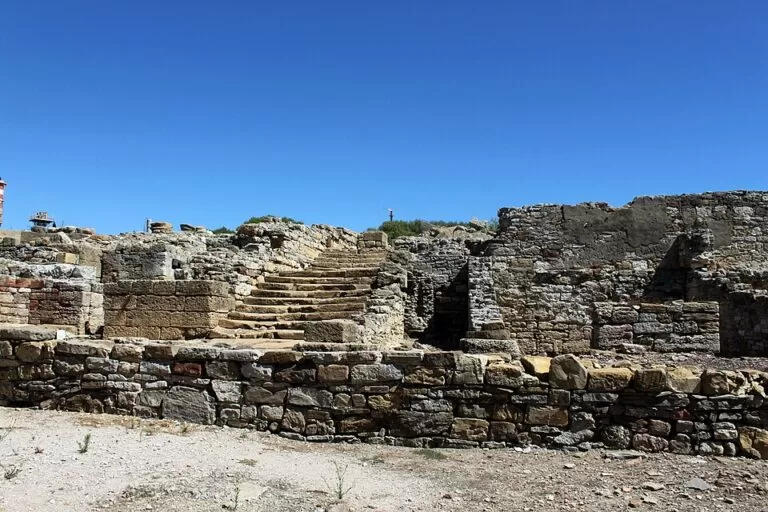
Historic siteCarteia is the Roman city on the shore of the Bay of Algeciras at Guadarranque, in the municipality of San Roque, about 3.5 km south-west of San Roque old town and 7.5 km from Algeciras. Its official name is the Enclave Arqueológico de Carteia, and you can only visit it on a guided tour booked in advance by email: free visits are not allowed for safety reasons (Andalucía.org). The car parks of Guadarranque beach, free on OpenStreetMap, are a short walk from the gate. It suits anyone interested in Roman Spain who plans ahead; skip it if you want to wander in on the day.
Quick facts
- Names: Carteia; officially Enclave Arqueológico de Carteia (Archaeological Site of Carteia). In Roman times Colonia Libertinorum Carteia.
- Where: Avenida del Puerto s/n, 11369 San Roque (Cádiz), next to Guadarranque beach (Andalucía.org).
- Coordinates: 36.1846, -5.4092 (OpenStreetMap).
- Founded: by the Carthaginians, a few hundred years after the Phoenicians settled about 2 km away in the 7th century BC (Andalucía.org).
- Roman status: in 171 BC the first Latin colony outside Italy (Andalucía.org).
- Protection: listed as a Bien de Interés Cultural, ref. RI-55-0000078 (OpenStreetMap).
- Visits: guided only, booked by email at carteia.aaiicc@juntadeandalucia.es; phone +34 956 908 030 or +34 600 143 014 (Andalucía.org, checked November 2026).
Access and parking
By car: the site lies between the A-7 and the bay at Guadarranque, in the industrial area of the bay; the nearest roads are the A-7 and the CA-P 2324 (spain.info). OpenStreetMap names the access road the Carretera de Acceso a Enclave de Carteia.
Parking: OpenStreetMap marks a free car park run by San Roque town council called Aparcamiento Enclave de Carteia, about 300 m west of the centre of the site, and two more free council car parks for Guadarranque beach a little further south.
Without a car: we could not find a bus stop or timetable that serves the site. Algeciras railway and bus stations are about 7.5 km away, so plan on a car or a taxi.
What to expect
The Andalusia tourism board describes a city founded by the Carthaginians, who took over the trade of the Phoenicians settled nearby. In the 3rd century BC the Romans greatly enlarged it and gave it monumental buildings, and in 171 BC, at the city’s request, the Senate in Rome made it the first Latin colony outside Italy, the Colonia Libertinorum Carteia. It stood a few metres from what is now Guadarranque beach, in a strategic position on the bay.
The tourism board lists what the visit covers:
- A Punic wall from the Carthaginian city.
- A Roman temple of the Republican period.
- A pool with a basilica plan and a bath building; OpenStreetMap maps the baths at the south end of the site.
- Several Roman houses (domus), a fish-salting factory and a large building from the reign of Augustus.
- Late Roman cemeteries of the 6th century AD and a large Roman theatre, mapped by OpenStreetMap about 250 m north-east of the main site.
- The Torre del Rocadillo, a 16th-century coastal watchtower ordered by Philip II, and a restored Second World War bunker, one of 500 built on the Cádiz coast against a possible attack from Gibraltar.
The setting is not a classical landscape: spain.info describes the surroundings of Guadarranque beach as industrial and rather neglected (spain.info), and the site sits between the river mouth and the industry of the bay.
Many finds from Carteia are in the Carteia section of the San Roque municipal museum, in Calle San Felipe in the old town: pieces from the port and the potters’ quarter, objects of daily life, remains of the Republican temple and a bull’s-head relief found in 1840. The museum also has workshops for children (Andalucía.org).
Prices and opening
All visits are guided and must be booked by email; the tourism board asks visitors to be punctual (Andalucía.org, checked November 2026). The listing gives no price or tour times, and the Junta de Andalucía and San Roque town hall websites could not be reached from our research setup, so ask about days, times and any fee when you book.
Accessibility and safety
The site is an open excavation with uneven ground, which is why free visits are not allowed. Wear closed shoes and bring water and a hat; we found no shade information. We could not confirm wheelchair access, so ask when you book. The San Roque museum in town holds a green accessibility seal, according to the tourism board.
Best time to visit
Book a week or more ahead and choose a cool morning outside high summer. Allow about an hour and a half for the tour. Combine it with the San Roque museum and the old town’s viewpoint over the bay and Gibraltar, 3.5 km away.
Nearby alternatives
- San Roque, 3.5 km away: the hill town founded by the Spanish people of Gibraltar in 1704.
- La Línea de la Concepción, 5.7 km away: the border town on the isthmus of Gibraltar.
- Los Barrios, 7.4 km away: the town at the head of the bay, with cork forests behind.
- Algeciras, 7.5 km away: the port city for ferries to Ceuta and Morocco.
- Marina de Sotogrande, 17.0 km away: the marina at the north-east end of San Roque’s coast.
- Castle of Guzmán el Bueno, 25.9 km away: the 10th-century fortress of Tarifa.
Distances are in a straight line from the site. For Baelo Claudia, the other Roman town of the Strait, and the whole stretch, see our Tarifa and the Strait of Gibraltar guide.
FAQ
Do you need to book to visit Carteia?
Yes. All visits are guided and must be booked by email at carteia.aaiicc@juntadeandalucia.es; you cannot walk round on your own (Andalucía.org).
Where is Carteia?
On the Bay of Algeciras at Guadarranque, in San Roque, next to Guadarranque beach and about 7.5 km from Algeciras.
Is there parking at Carteia?
Yes. OpenStreetMap shows a free council car park for the site about 300 m away, and free car parks for Guadarranque beach nearby.
Why is Carteia important?
In 171 BC it became the first Latin colony outside Italy, the Colonia Libertinorum Carteia (Andalucía.org).
Can I see finds from Carteia in a museum?
Yes, in the Carteia section of the San Roque municipal museum in Calle San Felipe (Andalucía.org).
Sources and freshness
Checked 7 November 2026 · 5 sources Show
Checked 7 November 2026. Official: Andalusia tourism board listings for the Enclave Arqueológico de Carteia (history, remains, booking, contact), the San Roque municipal museum and San Roque; spain.info’s sheet for Guadarranque beach. The Junta de Andalucía and San Roque town hall websites could not be reached. Location, car parks, theatre, baths, tower and distances: OpenStreetMap contributors (ODbL). Photos: Wikimedia Commons, licences as credited.
This place is part of our Costa de la Luz, Spain: beaches, towns, sherry and map — see every town, beach and cove we have mapped on that coast.
How this page is made. CostaMap is written with an AI editorial system run by Ebizapple. This page is based on the sources listed above. Last updated 6 November 2026. Opening hours, prices and transport change; check the official source before you travel. How we work · Partner links and ads