
Roda de Berà is a small beach town on the Costa Dorada, about 20 km north-east of Tarragona, best known for the Roman Arc de Berà on the N-340 at the edge of the municipality. Its coast has more than two kilometres of beaches with dunes, a 643-berth marina below the Roc de Sant Gaietà, a mock-historic village built in 1972, and a stage of the GR 92 coastal path. You reach it by car on the N-340 or AP-7, or by train to its own station. It suits families who want a quiet sandy beach and a Roman monument on the doorstep; skip it if you want a big old town, nightlife or museums every day.
Quick facts
- Names: Roda de Berà in Catalan; also written Roda de Barà, which is the form Catalunya.com uses in parts of its text. Spanish sources sometimes give Roda de Bará.
- Where: the north-east corner of the Tarragonès comarca, on the border with the Baix Penedès, Tarragona province, Catalonia. Its beach runs on from those of Creixell and Torredembarra (Catalunya.com).
- Coordinates: 41.1862, 1.4543 (the parish church of Sant Bartomeu in the old quarter, OpenStreetMap).
- Residents: 6,299, on 16 km² (Catalunya.com).
- Beaches: more than two kilometres, with a preserved dune ecosystem.
- Train: a station on the coast line, plus interurban buses (Catalunya.com).
- Known for: the Arc de Berà, a Roman arch on the line of the Via Augusta and part of the UNESCO World Heritage listing of Tarraco since 2000.
- Festivals: the Festa Major of Sant Bartomeu at the end of August, and a smaller town festival in mid-October.
Access and parking
By car: the N-340 coast road runs through the municipality and past the Arc de Berà; Catalunya.com gives the arch’s address as the Roda de Berà exit of the AP-7 motorway. Catalunya.com describes the car as the practical way to reach the beaches and the arch, while the centre and the seafront promenade are easy on foot and by bike.
Parking: Catalunya.com lists a car park at both Platja Llarga and Punta de la Guineu, by the Roc de Sant Gaietà.
By train and bus: Roda de Berà has a train station and interurban buses (Catalunya.com). At the Arc de Berà, OpenStreetMap shows a bus stop on each side of the N-340. Check current train lines and times with Rodalies de Catalunya before you travel.
What to expect
A quiet coastal municipality rather than a resort town. Catalunya.com says Roda lived almost entirely from farming until the second half of the 20th century, when it became a tourist centre of the Costa Daurada; today tourism, services and second homes drive the economy, and carob, almond and hazelnut fields are still common inland.
The Arc de Berà. The single-arched Roman monument stands on the N-340, which in many stretches follows the old Via Augusta. Catalunya.com gives it a height of 12.30 m, a width of 2.4 m and a length of 12 m, and dates it to between 15 and 5 BC. It was not built to celebrate a victory but probably to mark a territorial limit. Our Arc de Berà guide covers its history, its restorations and how to see it safely from the roadside.
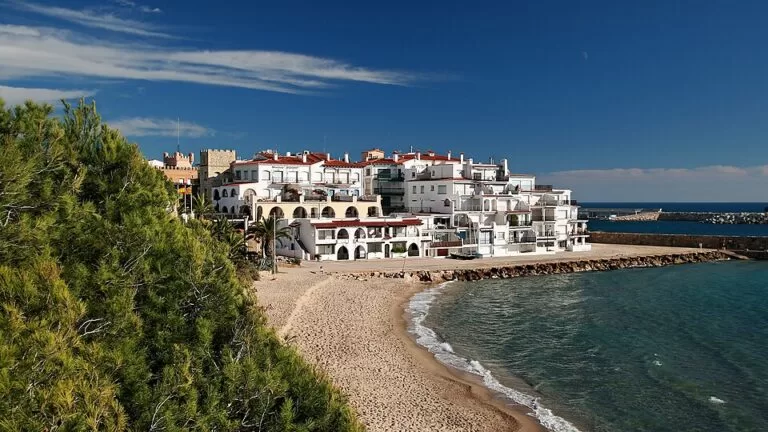
The beaches. Platja Llarga is about one kilometre long and nearly 90 m wide, with fine golden sand, calm water and a Blue Flag, according to Catalunya.com. It lists lifeguards, accessible entry with amphibious chairs and personal help, ramps, showers, portable toilets, a bar and restaurant, pedalo hire, a sports area, a children’s play area and a beach library. Several campsites lie close behind it. Further east, Punta de la Guineu is 900 m long and 25 m wide, beside the Roc de Sant Gaietà and the marina, with boat hire.
Roc de Sant Gaietà. A housing development built in 1972 on a rocky promontory, which Catalunya.com compares to the Poble Espanyol in Barcelona: it recreates the architecture of different places and periods of Spain.
The hermitage of Berà. On a small cliff by the seafront stand the 18th-century hermitage of the Mare de Déu de Berà and a viewpoint over the coast, next to the former Bank of Spain residence building.
The old quarter. Inland, the neoclassical parish church of Sant Bartomeu dates from the 17th century, and two old defence towers, Cucurull and Mas de Nin, survive. The La Roca Foradada civic centre holds a permanent exhibition of sculptures by Salvador Dalí, lent by the founder who cast them, the Writer’s Museum, and since 2012 the Luis del Olmo radio museum, with more than 240 radio sets (Catalunya.com). Check opening times locally: we could not open the town’s own website.
Practical details
- Walking: the town has six signposted routes under the name Roda Verda; Catalunya.com says they can be done with a guide in summer and at Easter.
- Coastal path: the GR 92 stage from Calafell to Torredembarra (15.04 km, about 3 h 45 min, 124 m of ascent, beginner level) passes the Roc de Sant Gaietà on a stretch of camí de ronda and the Berà hermitage (Catalunya.com).
- Marina: the Port de Roda de Berà opened in early 2008 between the Les Guineus and La Pellisseta beaches, sheltered by the Roc de Sant Gaietà, with 643 berths for boats of 8 to 30 m (Catalunya.com).
- Tourist information: the Patronat Municipal de Cultura, Turisme i Esports of Roda de Berà; Catalunya.com gives the town’s address as Carrer Joan Carles I 15.
Accessibility and safety
Platja Llarga and Punta de la Guineu both list access for people with reduced mobility, with personal help and amphibious chairs (Catalunya.com); we could not confirm the dates this service runs. Catalunya.com notes that Punta de la Guineu is hard to reach on foot. The Arc de Berà stands between the two carriageways of the busy N-340: do not stop on the road, and cross only where it is safe. Lifeguards are listed for the main beaches but only in the bathing season.
Best time to visit
June to September for the beaches, when the services listed above run. The Festa Major of Sant Bartomeu fills the end of August. Spring and autumn suit the Roda Verda routes and the coastal path, which Catalunya.com rates as possible all year; autumn is the rainiest season.
Nearby alternatives
- Arc de Berà, 1.9 km: the Roman arch on the N-340, free to see from outside.
- Torredembarra, 6.6 km: the Els Muntanyans dunes and a lighthouse you can climb in summer.
- HolaCamp Sant Salvador, 6.8 km: a campsite near the Sant Salvador beach in El Vendrell.
- El Vendrell, 7.7 km: the Coma-ruga and Sant Salvador beaches and the Pau Casals houses.
- Altafulla, 8 km: a walled old village and a kilometre of sand.
- Tarragona, about 18 km: the Roman amphitheatre and the cathedral.
Distances are in a straight line from the old quarter of Roda de Berà.
FAQ
Where is Roda de Berà?
On the Costa Dorada in Tarragona province, Catalonia, about 20 km north-east of Tarragona on the N-340, between Creixell and Torredembarra to the south-west and El Vendrell to the north-east.
Is Roda de Berà good for families?
Yes, for a beach holiday. Platja Llarga has fine sand, calm shallow water, a Blue Flag, lifeguards, a play area and a beach library, according to Catalunya.com. Evening life is limited.
How do I get to Roda de Berà by train?
Roda de Berà has its own station on the coast line, with interurban buses as well. Check Rodalies de Catalunya for the current lines and times before you travel.
Can you visit the Arc de Berà?
Yes. It stands in the open by the N-340 and is free to see from outside; there is no visitor centre. Stop in town rather than on the road.
Sources and freshness
Checked 7 November 2026 · 7 sources Show
Checked 7 November 2026. Official: Catalunya.com (Catalan Tourist Board) on Roda de Berà (heritage, routes, festivals, population, history, transport), Platja Llarga, Punta de la Guineu – Roc de Sant Gaietà, the Arc de Berà, the marina and GR 92, Calafell to Torredembarra. The town hall website could not be opened from our research setup. Location, bus stops and distances: OpenStreetMap contributors (ODbL). Photos: Wikimedia Commons, licences as credited.
This place is part of our Costa Dorada map and travel guide: Roman Tarragona, Salou and the Ebro Delta — see every town, beach and cove we have mapped on that coast.
How this page is made. CostaMap is written with an AI editorial system run by Ebizapple. This page is based on the sources listed above. Last updated 6 November 2026. Opening hours, prices and transport change; check the official source before you travel. How we work · Partner links and ads