
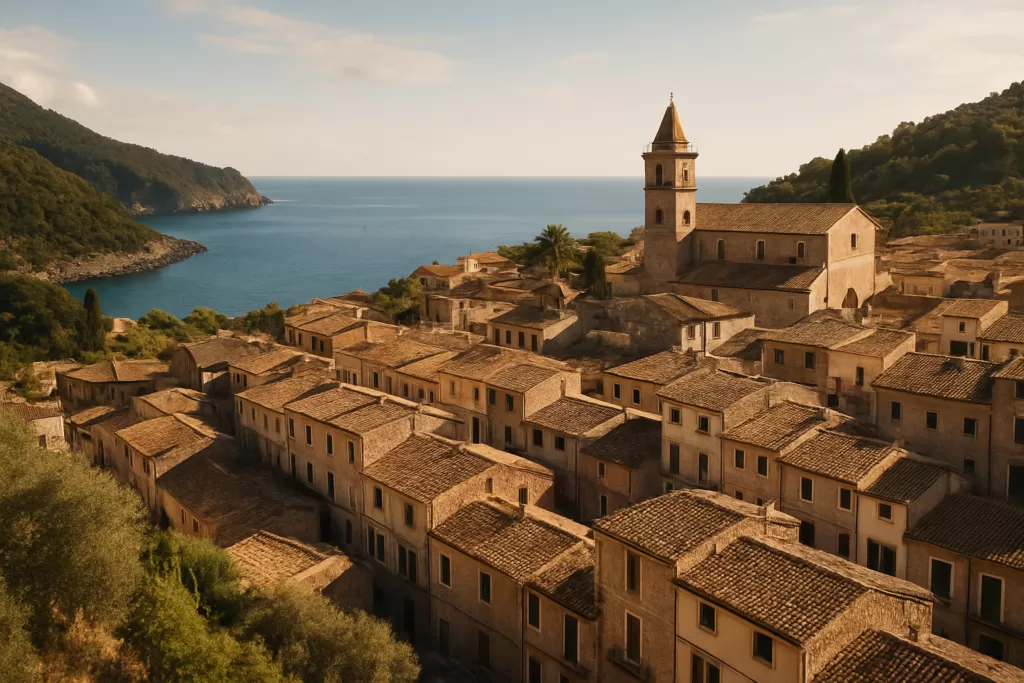
Bunyola: Serra de Tramuntana and the Soller Train on Mallorca
Bunyola is a Tramuntana village of 7,642 people (INE 2025), about 15 km north of Palma, with a stop on the historic Ferrocarril de Sóller: the wooden train takes about 25 minutes to Palma and 20 to Sóller. Two of Mallorca’s best-known garden estates, Raixa and the Jardins d’Alfàbia, lie within the municipality, and the mountain road to the Orient valley starts here. Come for gardens, the train and walking; there is no beach.
Bunyola at a glance
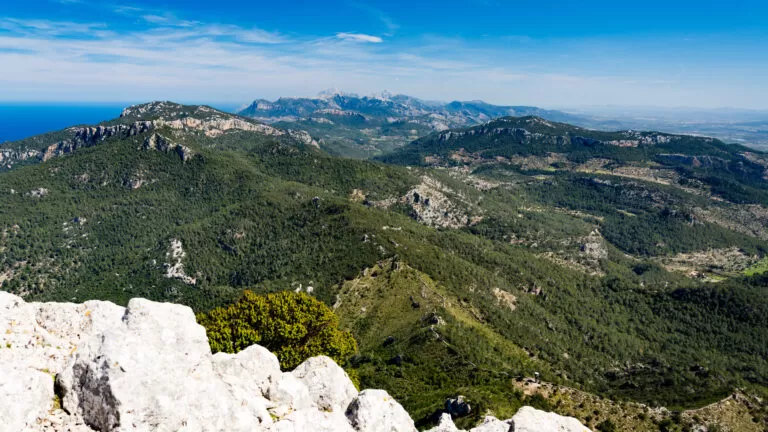
- On the southern slope of the Serra de Tramuntana (UNESCO World Heritage since 2011). Spanish name: Buñola.
- Population 7,642 (INE 2025); area 84.6 km².
- Settlements: Bunyola village, Orient, Palmanyola, Sa Font Seca and several newer estates.
- Train: Bunyola station on the Ferrocarril de Sóller (opened 1912), 0.5 km from the main square.
- Buses: TIB lines 205 and 303 to Palma.
- Distances (straight line): Palma 14.8 km, Palma airport 16.2 km, Raixa 2.9 km, Jardins d’Alfàbia 2.2 km, Orient 6.6 km.
- Fiestas: Mare de Déu de les Neus (5 August), Sant Mateu, patron saint (21 September), Santa Bàrbara (4 December).
Before you plan
Raixa, once owned by fashion designer Jil Sander and now public property of the Consell de Mallorca, reopened to visitors in late 2018, but OpenStreetMap lists only weekend morning opening. Alfàbia charges an entry fee, according to OpenStreetMap. Neither official website could be reached from our research setup, so confirm hours before you travel.
Bunyola on the map
Beaches, sights and nearby towns with a CostaMap page. Click a pin to open it, or switch to places to stay.
Things to do in Bunyola
A good day combines the train, one garden estate and a walk through the village’s stepped lanes. Add the drive or bike ride to Orient if you have a car.
| Attraction | What it is | Price/entry | Best for |
|---|---|---|---|
| Raixa | Italian-style villa and monumental gardens, remodelled by Cardinal Despuig in the 18th century; museum rooms on the Tramuntana | Free per OpenStreetMap (weekend mornings) | Garden lovers, culture |
| Jardins d’Alfàbia | Historic gardens of a former Islamic farmstead near the Coll de Sóller, with lily ponds, fountains and a water pergola | Fee; OpenStreetMap lists daily 09:30–18:30 | Gardens, architecture |
| Ferrocarril de Sóller | Wooden heritage train (since 1912) on the 27 km Palma–Sóller line, stopping at Bunyola | Fares from the operator | Rail fans, families |
| Església de Sant Mateu and the Pujadors | Baroque parish church on Sa Plaça and the stepped stone lanes of the old village | Free | Short stroll |
| Orient valley | Enclosed mountain valley and hamlet, 6.6 km north-east | Free | Walkers, cyclists |
Raixa and Alfàbia
Raixa, 2.9 km south-west of the village, began as an Islamic estate and was turned into an Italian-style villa by Cardinal Despuig in the 18th century. Its gardens by Pietro Lazzarini have a grand staircase, a large pond, a romantic garden with small temples and a hedge maze; the house also has an olive press, cellar and museum rooms about the Serra de Tramuntana. It was a location for the 1982 film Evil under the Sun. OpenStreetMap shows a free car park beside it. The Jardins d’Alfàbia, 2.2 km north of the village on the Ma-11, belong to a former Islamic farmstead whose manor house mixes Arab, Gothic, Renaissance and Baroque elements; a bus stop named after the gardens sits on the Ma-11.
Ride and watch the Sóller train
The Ferrocarril de Sóller has run its wooden trains since 1912 on a 27 km line from Palma over the Tramuntana to Sóller, through tunnels and over mountain bridges. Bunyola station is on the edge of the village, 0.5 km from Sa Plaça. From here it takes about 25 minutes to Palma and about 20 minutes to Sóller, so you can ride just the mountain section instead of the whole line.
Village lanes, Orient and the Comuna
The old village climbs the hillside on the Pujadors, stepped stone lanes protected as a local Bé d’Interès Cultural. The Baroque church of Sant Mateu, begun in 1634–35 on the site of a Gothic church, faces Sa Plaça and the old town hall. North of the village, Sa Comuna de Bunyola is a public pine and holm-oak forest with old charcoal-burners’ paths and lime kilns. The Ma-2100 and Ma-2110 roads climb to the Orient valley, a fertile basin drained by the Coanegra torrent and popular with cyclists, and continue to Alaró. The GR 221 dry-stone route also passes through the municipality.
Bunyola with kids
The train is the obvious hit: a short ride from Bunyola to Sóller through the tunnels takes about 20 minutes. Raixa’s gardens, maze and pond suit families. There are no theme parks; for a beach, head to the coast around Palma, about 15 km away.
How to get to Bunyola and get around
- By train: Ferrocarril de Sóller from Palma, about 25 minutes to Bunyola station.
- By bus: TIB line 205 (Palma–Bunyola) and line 303 (Palma–Hospital Joan March–Bunyola) stop at Sa Plaça (stop 10025) and Costa de s’Estació. Palmanyola, on the Ma-11, has regular buses to Palma and the university.
- By air: Palma airport is 16.2 km away in a straight line.
- By car: the Ma-11 Palma–Sóller road passes the municipality, with a branch into the village; the 3,023 m Sóller tunnel has been toll-free since 2017. The Ma-2100 links Bunyola with Santa Maria del Camí over the Coll d’Honor.
- Parking: OpenStreetMap shows paid car parks at Can Gual near the square and a 40-space underground car park on Santa Catalina Thomàs; spaces are tight in the old village.
Where to stay in Bunyola
Stay in the village to walk to the train and Sa Plaça. Rural fincas around Orient suit walkers and cyclists who want quiet nights; check booking sites for availability. Palma, 15 km away by train or bus, has the widest choice and makes Bunyola an easy day trip.
Best time to visit the area
The climate is Mediterranean, with mild winters and hot, dry summers; average temperatures run from about 10–15 °C in January to 25–30 °C in July, and most of the 500–600 mm of yearly rain falls in autumn and winter. Spring and autumn are best for walking and cycling. Fiesta dates: Mare de Déu de les Neus on 5 August, the festa major of Sant Mateu in the week of 21 September, and Santa Bàrbara on 4 December.
History of Bunyola
Talaiotic remains (about 1300–123 BC) survive on estates such as Coma-sema and Son Palou, and Roman-era silver-bearing galena was mined at Son Creus. In the Islamic period (903–1229) Bunyola belonged to the district of Bunyûla-Mûsû. After Jaume I’s conquest, estates such as Alfàbia, Biniatzar and Raixa were shared out among the conquerors. The name probably comes from the Latin vineola, “little vineyard”, recorded as Bunnola in 1232. The present church was begun in 1634–35. The Sóller railway arrived in 1912, and from the 1970s the population grew quickly, from 2,622 in 1970 to 7,115 in 2021, as Bunyola became part of Palma’s commuter belt. During the Civil War local progressive leaders were persecuted and the Nadal family distillery was looted.
Practical info
- Residents are called bunyolins.
- Distances (straight line): Palma 14.8 km, airport 16.2 km, Alaró 7.9 km, Orient 6.6 km.
- Highest points: the Serra d’Alfàbia reaches 1,067 m and the Puig de n’Alí 1,035 m on the border with Sóller.
- Garden hours above are from OpenStreetMap (checked November 2026); confirm with Raixa and Alfàbia before visiting.
Worth it for: the Sóller train, two outstanding garden estates, Tramuntana walking and an easy trip from Palma. Less so if: you want beaches, nightlife or a big choice of shops and restaurants.
How we assess this guide
This is desk research, checked on 6 November 2026. History, the estates, train times, roads and fiestas come from the English, Spanish and Catalan Wikipedia articles on Bunyola; bus lines, stops, car parks, garden hours and coordinates come from OpenStreetMap, with straight-line distances we calculated. We did not visit, and the town hall, Raixa, Alfàbia and Sóller railway websites could not be reached when we checked, so check fares and opening hours with them.
Frequently asked questions
Does the Sóller train stop in Bunyola?
Yes. Bunyola station is 0.5 km from the main square; the train takes about 25 minutes to Palma and about 20 minutes to Sóller.
How do I get from Palma to Bunyola by bus?
TIB lines 205 and 303 run from Palma to Bunyola; stops in the village include Sa Plaça and Costa de s’Estació.
Can you visit Raixa?
Yes. Raixa is owned by the Consell de Mallorca and reopened in late 2018. OpenStreetMap lists free entry on Saturday and Sunday mornings; check before you go.
How far are the Jardins d’Alfàbia from Bunyola?
2.2 km north of the village in a straight line, on the Ma-11 towards the Coll de Sóller, with their own bus stop.
Is there parking in Bunyola?
Yes, but it is limited in the old village. OpenStreetMap shows paid parking at Can Gual near Sa Plaça and an underground car park on Santa Catalina Thomàs.
Does Bunyola have a beach?
No. The village is inland; the nearest beaches are on the coast around Palma, about 15 km away.
When is the Bunyola festa major?
In the week of 21 September, for the patron saint Sant Mateu.
Plan the wider trip
Sources and freshness
Checked 6 November 2026 · 4 sources Show
Checked 6 November 2026. Wikipedia: Bunyola (English), Buñola (Spanish) and Bunyola (Catalan). Bus lines 205 and 303, stops, Bunyola station, car parks, Raixa and Alfàbia opening data and coordinates: OpenStreetMap, © OpenStreetMap contributors (ODbL); straight-line distances calculated by CostaMap. The town hall, Raixa, Alfàbia and Ferrocarril de Sóller websites could not be reached when we checked, so fares and current opening hours are not confirmed.
Places worth knowing near Bunyola
How this page is made. CostaMap is written with an AI editorial system run by Ebizapple. This page is based on the sources listed above. Last updated 6 November 2026. Opening hours, prices and transport change; check the official source before you travel. How we work · Partner links and ads