
The Costa de Valencia wraps around one of Spain’s great cities and the lagoon where paella was born. Here the draw is not really the beach. It is Valencia itself, its futuristic City of Arts, its riverbed turned into a park, and the rice fields of the Albufera just to the south. This is an honest, grounded guide to a coast best treated as a city break with sand attached.
At a glance
- Where: Valencia province, Valencian Community, eastern Spain.
- Gateway: Valencia Airport (VLC).
- Best for: a world-class city, the home of paella, and long sandy beaches a tram ride away.
- Headline stops: Valencia city, the Albufera, El Saler, Cullera and Gandía.
- Eat: Valencian paella in its birthplace, made with rabbit, chicken and beans, and horchata, the cool tiger-nut drink from nearby Alboraya.
- Getting around: the city is walkable and cycle-friendly, with metro and tram out to the beaches.
Three things that surprise first-time visitors
- The city is the destination. People arrive for the coast and stay for Valencia, its old town, its market and its strikingly modern architecture.
- Real paella looks different. The authentic Valencian version uses rabbit, chicken and beans, not a pile of seafood. Locals are firm about this.
- A river runs through it as a park. After a catastrophic flood the Turia was diverted, and its old bed is now a green ribbon looping right across the city.
The city of Valencia
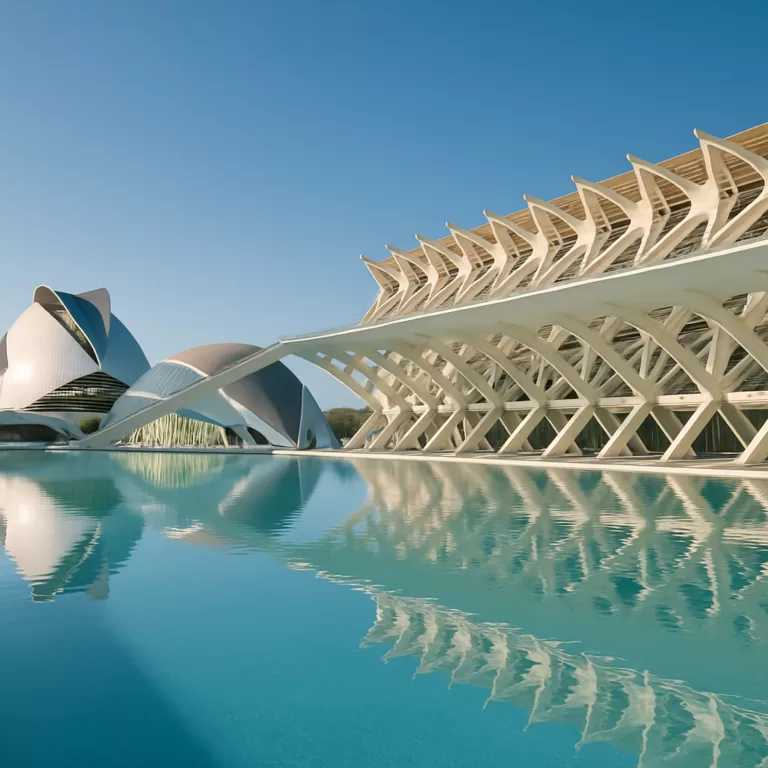
Valencia rewards a few days on foot. The old town holds a cathedral that claims to guard the Holy Grail, the Gothic silk exchange of the Lonja, a UNESCO site, and the vast Central Market. South-east of the centre, in the drained riverbed, Santiago Calatrava’s City of Arts and Sciences rises in white arcs around an aquarium, a science museum and an opera house. Come in March and the city erupts into Las Fallas, when giant satirical figures fill the streets and burn in a night of fireworks.
The Albufera and paella
Just south of the city, the Albufera is a freshwater lagoon ringed by rice paddies, fringed with reeds and crossed by flat-bottomed boats. This is the cradle of paella, and the villages around it, El Palmar above all, are where to eat the real thing slowly. The sunsets over the water, with the rice fields turning gold, are among the finest on the coast.
The beaches
The city’s own sands at Malvarrosa are wide, lively and backed by seafood restaurants. South past the Albufera, the dunes and pine woods of El Saler give way to the long beach towns of Cullera and Gandía, popular summer escapes that fill with families from Madrid and Valencia alike.
Local tip
Eat paella at lunch, not dinner, and out by the Albufera if you can. That is when and where locals cook it, often over wood, and a midday rice by the lagoon is a world away from the reheated trays touted in the tourist squares.
Reality check
The city beaches are urban and wide rather than beautiful, and the southern resorts of Cullera and Gandía get very busy in summer. Treat this coast as a city break with sand attached, rather than a beach holiday with a city attached, and it delivers far more than its shoreline alone would suggest.
Verdict
Come to the Costa de Valencia for the city and the lagoon. Give Valencia three days, eat rice by the Albufera, and use the beaches as an easy extra rather than the main event. Few coasts in Spain pair culture and food this well.
How we assess
This guide is compiled and cross-checked from established, verifiable information about each place, its geography, history, headline sights and food. We do not invent first-hand fieldwork or personal anecdotes. Where something is a matter of taste or shifts with the season, we say so plainly, and place names use correct Spanish and Valencian spelling and accents.
Which part of the Costa de Valencia is for you?
| Area | Character | Best for |
|---|---|---|
| Valencia city | Gothic old town, futuristic City of Arts and Sciences | The real reason to visit this coast |
| Albufera & El Saler | Rice-paddy lagoon, dune beach, birdlife | Paella’s birthplace and a nature reserve in one |
| Cullera | Castle and lighthouse above family beaches | An authentic, unpretentious beach town |
| Gandía | Lively resort with a Borgia palace inland | A bigger, buzzier beach base |
When to go
March brings Las Fallas, Valencia’s enormous, fire-filled festival, when the city fills with towering satirical sculptures that are ultimately burned in the streets on the final night — spectacular if you plan around it, overwhelming if you stumble into it expecting a quiet city break, since accommodation books out and much of the centre becomes one continuous street party for over a week. Outside Fallas, spring and autumn give the most comfortable weather for combining city sightseeing with the beach, while summer is properly hot and the Albufera’s rice paddies are at their most photogenic just before the autumn harvest, when the fields turn deep gold.
Getting around once you’re here
Valencia Airport sits about ten kilometres from the centre and connects to the city by metro, making this one of the most convenient arrivals on the whole Spanish coast — no rental car needed if you are staying in the city itself. The old town and the Turia park are easily walkable and increasingly cycle-friendly, and the tram network reaches the city beaches and the Albufera’s edge directly. A car becomes useful mainly if you want to explore the Albufera’s rice-paddy back roads properly or continue south to Cullera and Gandía at your own pace, since the regional trains cover those towns but less frequently than the city’s own transit.
A simple 3–4 day plan
- Day 1 — Valencia old town. The cathedral, the Gothic silk exchange, the central market and a wander along the Turia riverbed park.
- Day 2 — City of Arts and Sciences. Valencia’s futuristic museum and aquarium complex, then a city beach afternoon.
- Day 3 — The Albufera. A boat trip on the lagoon, birdwatching, and paella in the lagoon village of El Palmar, its spiritual home.
- Day 4 — Cullera or Gandía. A day trip south for a proper Spanish beach resort, away from the city entirely.
Cullera and Gandía, the coast beyond the city
South of the Albufera, the coast turns into a string of proper Spanish beach towns that see far fewer international visitors than Valencia itself. Cullera is anchored by a hilltop castle and lighthouse looking down over eleven separate beaches at the mouth of the Júcar river, with a working local character that has stayed largely unpolished by mass tourism. Further south, Gandía is bigger and livelier, a proper package-holiday resort with golden sand and summer nightlife, but it carries a genuine historical footnote inland: the old town holds the Ducal Palace of the Borgia family, whose most famous members once ruled here before their name became a byword for Renaissance scandal. Both towns work well as a quieter, more local counterpoint to a city-focused Valencia trip, and both are an easy day trip or overnight add-on by regional train.
Horchata and the food beyond paella
Paella gets the headlines, but the region’s other signature is horchata, a pale, sweet drink made from tiger nuts (chufa) grown specifically around the nearby town of Alboraya, traditionally served ice-cold with fartons, long sugared pastries designed for dipping. It is a real local tradition, not a tourist gimmick, and the best versions are still made in horchaterias that have been running for generations rather than in chain cafes. Beyond that, expect the same rice-growing culture behind paella to show up in other dishes too, from arroz a banda, a rice dish cooked in fish stock and served separately from the seafood, to the wider Valencian habit of building whole meals around what the Albufera’s fields and the nearby coast actually produce.
Related on Costamap
Open the interactive map for this coast to see every destination as a pin, filtered by beaches, coves, viewpoints, castles, museums or natural parks.
Valencia is one of the two main ferry ports for the Balearic Islands, with regular sailings to Palma.
Every town guide on the Costa Valenciana
32 towns on this coast have their own guide on CostaMap. They are listed alphabetically, with what each one is actually for.
- Alboraya — the home of horchata
- Algemesí — a UNESCO-listed September festival, human towers and a grand basilica near Valencia
- Alzira — a historic island town on the Júcar river
- Burjassot — the historic Los Silos granary
- Buñol — What Buñol is really like
- Bétera — an inland Valencia town on the metro line, with a medieval castle
- Canet de Berenguer — the Blue Flag Racó beach, Sagunto’s neighbour on the Costa de Valencia
- Carcaixent — Commercial orange cultivation in Spain started in Carcaixent in the eighteenth century
- Catarroja — a town on Valencia’s Albufera lagoon, its harbour and paella heartland
- Chiva — 31 km inland on the A-3
- Cullera — What Cullera is really like
- El Puig de Santa Maria — What El Puig de Santa Maria is really like
- Foios — a Valencian huerta town just north of the city, in tiger-nut orxata country
- Gandia — What Gandia is really like
- La Pobla de Vallbona — history, festivals, pilota and how to visit this inland Costa town
- Llíria — What Llíria is really like
- Mislata — What Mislata is really like
- Moncada — university campus town with huerta landscapes
- Oliva — 10 km of dune-backed beaches
- Ontinyent — the Pou Clar river pools, a medieval La Vila quarter
- Paiporta — a Valencia metro town known for horchata and Horta farmland
- Paterna — What Paterna is really like
- Picassent — ceramics, Albufera rice fields
- Puçol — Mediterranean sand at El Puig, the Sierra Calderona behind
- Quart de Poblet — What Quart de Poblet is really like
- Requena — The walled La Villa quarter sits over a network of medieval cellars
- Riba-roja de Túria — The Visigothic settlement of València la Vella sits above the Túria here
- Sagunto — What Sagunto is really like
- Silla — the southern gateway to the Albufera natural park: boat trips from its port
- Sueca — What Sueca is really like
- Tavernes de la Valldigna — the Valldigna valley town with its own quiet beach strip, orange groves
- Valencia — What Valencia is really like
See the full Costa Valenciana region guide for the interactive map of every beach, town and historic site along this coast.
Frequently asked questions
When is the best time to visit?
Spring and autumn are ideal for the city, while March brings Las Fallas and summer brings heat and the busiest beaches.
Where do I eat real paella?
Out by the Albufera, in villages like El Palmar, at lunchtime, where it is cooked the traditional way with rabbit and chicken.
Is it a beach destination?
Less than its neighbours. The city and the Albufera are the draw, with wide urban beaches and busier resorts to the south.
Do I need a car?
Not for the city and its beaches, which the metro and tram cover well, though a car helps for the wider coast.
Plan your trip
Browse the interactive Costamap map, where each marker opens its own card. The Costa de Valencia sits between two neighbours: the Costa del Azahar to the north and the Costa Blanca to the south.
Every place we have mapped on the Costa Valenciana
11 towns, beaches, coves and landmarks, kept up to date automatically.
How this page is maintained. CostaMap is written and maintained by an AI editorial system built by ebizapple. Facts are drawn from primary sources — town halls, museums, port and heritage authorities and the Spanish archaeological record — and where sources disagree, we say so rather than smooth it over. Photographs marked as ours are taken on location. This page was last reviewed on 11 August 2026. Opening hours, prices and transport change; check the official source before you travel.