
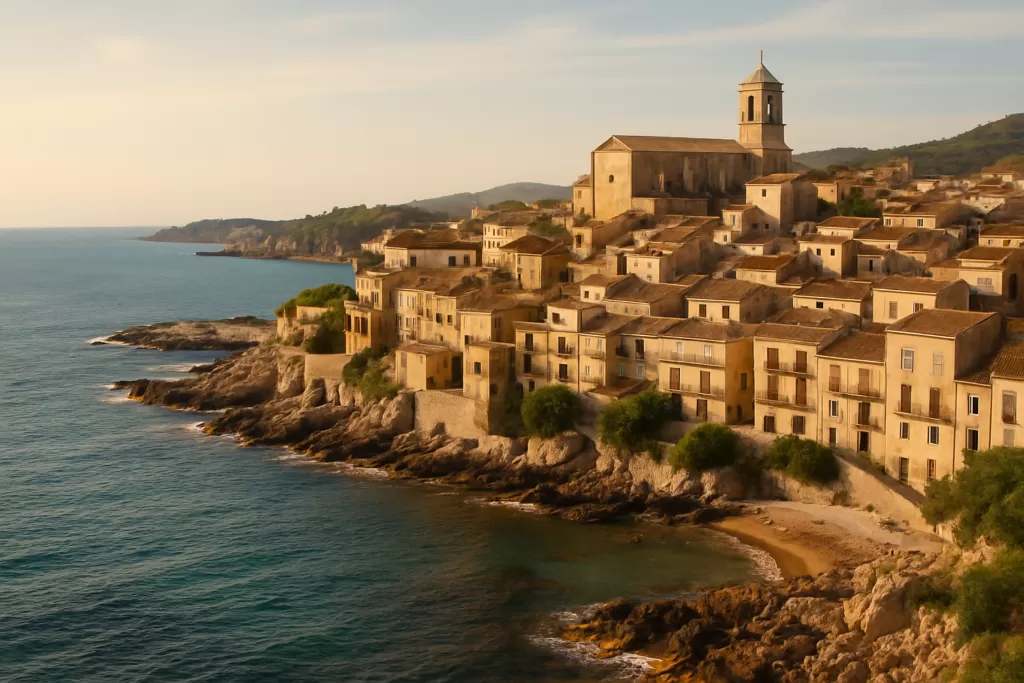
Sant Joan: Pla de Mallorca village of botifarró
Sant Joan is a farming village of about 2,300 people in the Pla de Mallorca, the flat interior of the island, 33.5 km east of Palma in a straight line and 27 km from Palma airport. It is known for the Festa del Botifarró sausage fair in early October, the hilltop Santuari de Consolació just outside the village, and old Mallorcan traditions such as its dimonis (devils). Come for a quiet half day, a festival or a country-house museum; there is no beach, the nearest coast at Can Picafort is about 21 km away.
Sant Joan at a glance
- Location: centre of Mallorca, Pla de Mallorca comarca; Spanish name San Juan, formerly Sant Joan de Sineu.
- Population: 2,336 (INE 2025). Founded as a vila in 1300 under the Ordinacions of James II.
- Neighbours: Petra and Vilafranca de Bonany to the east, Porreres to the south, Montuïri to the west, Lloret de Vistalegre to the north-west and Sineu to the north.
- Landmarks: Santuari de Consolació (0.6 km), the parish church in the centre, several old windmills, and the Els Calderers country-house museum (2.2 km).
- Hills: Puig de Bonany (310 m) in the south-east of the municipality and Puig de Sant Nofre (254 m) to the north.
- Getting there: by car, or TIB bus route 442 to the village; the nearest open train stations are Sineu (5.9 km) and Petra (6.6 km).
- Festivals: Quart Diumenge (fourth Sunday of Lent), Sol que Balla (24 June), patron saint Sant Joan Degollat (29 August), Festa del Botifarró (early October).
Before you plan
The train halt called “Sant Joan” on the Inca–Manacor line actually lies in Sineu’s municipality and closed in February 2012. Use Sineu or Petra stations instead, or the bus. The Festa del Botifarró is held in early October; check the exact weekend with the town hall before you travel.
Sant Joan on the map
Beaches, sights and nearby towns with a CostaMap page. Click a pin to open it, or switch to places to stay.
Things to do in Sant Joan
The village is small and walkable. A visit usually means climbing the stairs to the Consolació sanctuary, a walk past the windmills and the church, coffee in the centre and, if you have a car, the Els Calderers estate. Expect a morning or an afternoon unless a festival is on.
| Attraction | What it is | Price/entry | Best for |
|---|---|---|---|
| Santuari de Consolació | The village’s first church, on a hill reached by a long cobbled stairway; rebuilt 1755–1780 | Free to walk up | History, quiet walk |
| Casa Museu Pare Ginard | Birthplace of folklorist Rafel Ginard, opened as a museum in 2007 | Check locally | Mallorcan song and folklore |
| Els Calderers | Country estate documented since 1278, a house museum of rural life since 1993 | Check opening times | Families, rural history |
| Festa del Botifarró | Early-October fair around the local botifarró sausage, also called the Festa de sa Torrada | Free to enter | Food lovers |
The Consolació sanctuary
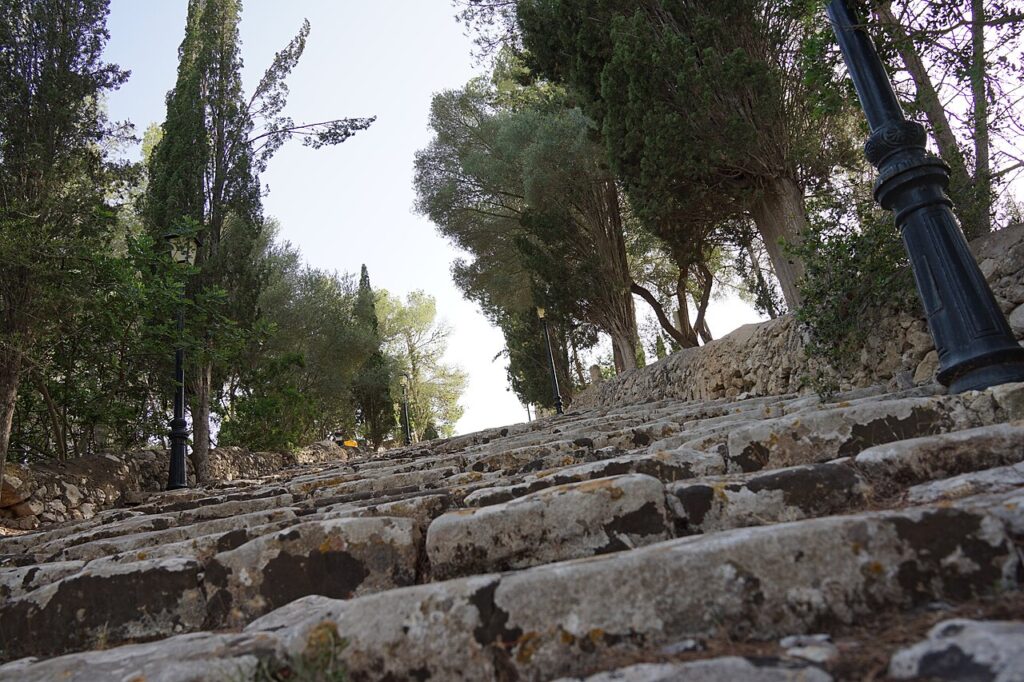
The Santuari de la Mare de Déu de Consolació stands on a low hill (pujol) 0.6 km south-west of the centre, reached by a long, wide cobbled stairway that ends at an esplanade over a cistern, decorated with two sundials. A chapel dedicated to Saint John the Baptist stood here before 1249; it became the parish church when Sant Joan’s parish was created in 1298. The village was laid out lower down in 1300, and from 1416 the villagers raised money for a new church in the centre, finished in the mid-16th century. The old church was then restored in the mid-18th century and rededicated to the Virgin of Consolation; the venerated image dates from the mid-16th century. A round doorway in the courtyard is thought to survive from the first 13th-century oratory. Next door, Cas Donat, a simple late Gothic house, served as the village rectory. OpenStreetMap shows two small car parks at the foot of the hill. The Sol que Balla (“dancing sun”) festival has been held at the sanctuary every 24 June since 1983.
The village centre, church and windmills
The parish church of Sant Joan, built between the 15th and 16th centuries, stands in the centre near the town hall. Cafés such as Can Tronca, Can Covent and Es Centro sit around it on OpenStreetMap. One of the village’s named districts is els Molins, “the mills”, and OpenStreetMap maps about ten old windmills within 700 m of the centre, including the Molí d’en Tronca, Molí de Can Carritxó and Molí d’en Reüll. The Casa Museu Pare Ginard, in the house where Rafel Ginard i Bauçà was born in 1899, shows the songs, gloses and folk tales he collected for his four-volume Cançoner Popular de Mallorca (about 5,000 songs in the first volume alone); the house keeps an old animal-driven mill and a wine press.
Els Calderers
Els Calderers, 2.2 km east of the village, is a country estate first recorded in 1278. The present houses date from the first half of the 18th century: the owners’ house around a central courtyard, the farm manager’s house, stables and other farm buildings. It has been a house museum of traditional rural life in the Pla de Mallorca since 1993, and the houses, outbuildings and stables can be visited. Check current opening times and prices before you go.
Festivals and food culture
Sant Joan celebrates eight festivals a year. The Festa del Botifarró, or de sa Torrada, in early October is the best known outside the village and centres on botifarró, the Mallorcan blood sausage. The Quart Diumenge, or festival of bread and fish, falls on the fourth Sunday of Lent. The patron saint’s festival, Sant Joan Degollat on 29 August, brings a correfoc fire run, a solemn Mass and the dimonis: seven devil costumes by Antoni Roig i Sierra, one for each deadly sin, first shown in 1983. The Diables de Sant Joan, the first devil troupe in the Balearic Islands (1993), run the correfoc with the Corb de Sant Nofre, a two-headed crow created in 1998 and the first fire beast made in the islands.
Best beaches in Sant Joan
Sant Joan is inland and has no beach. Its streams drain north to the Bay of Alcúdia, and the nearest resort on that bay, Can Picafort, is about 21 km away in a straight line.
Sant Joan with kids
The village suits short, low-key family outings. Children usually enjoy climbing the stairway to Consolació, spotting the windmills, and the stables and old farm buildings at Els Calderers. The patron saint’s festival in late August, with devils and fire, is exciting for older children but loud and crowded; keep young ones back from the correfoc.
How to get to Sant Joan and get around
A car is the easiest way to combine Sant Joan with other Pla villages. OpenStreetMap shows stops on TIB bus route 442 (operator Sagalés Caldentey) on the edge of the centre. The old Sant Joan rail halt is closed; a bus has linked the village centre with Sineu station since 2012. Inside the village, everything is within a 10-minute walk. Straight-line distances from the village centre:
| From | By | Approx distance |
|---|---|---|
| Palma (Plaça de Cort) | Car or bus | 33.5 km |
| Palma airport (Son Sant Joan) | Car | 27.0 km |
| Sineu station | Train on the Inca–Manacor line, then bus or taxi | 5.9 km |
| Petra station | Train, then taxi | 6.6 km |
| Can Picafort (nearest beach resort) | Car | 21.5 km |
Where to stay in Sant Joan
Sant Joan is a small village, so the choice of places to stay is narrow. Options fall into two types:
- The village centre: a few steps from the church, the cafés and the Ginard museum.
- The countryside: rural houses on the plain, which is dotted with sixteen protected historic possessions (country estates); check booking sites for what is open.
Best time to visit Sant Joan
The interior is hotter in summer than the coast, often above 35 °C, and colder on winter nights, when it can drop below 5 °C. Rain falls mainly in autumn and spring. Pick your dates by festival:
| Season | Months | What to expect |
|---|---|---|
| Spring | March or early April (fourth Sunday of Lent) | Quart Diumenge, the festival of bread and fish; mild walking weather |
| Summer | 24 June; 29 August | Sol que Balla at Consolació; patron saint’s festival with dimonis and correfoc |
| Autumn | Early October | Festa del Botifarró (sa Torrada) |
History of Sant Joan
More than forty archaeological sites, from the pre-Talaiotic to the Roman period, have been found in the municipality, including the Talaiotic necropolises of Carrutxa and Son Gil. Under Islamic rule the area belonged to the district of Yiynaw-Bitra. After James I’s conquest the land was shared out in the Llibre del Repartiment, and a chapel to Saint John the Baptist was built on the Consolació hill by 1249 to serve settlers far from Sineu’s parish church. The parish became independent in 1298, and in 1300 Sant Joan became a vila under the Ordinacions of James II. Plague, the Revolta Forana of 1450 and the Germania revolt of the 16th century hit the village hard; about a hundred villagers joined the Germania. For centuries the economy rested on cereals, vines and livestock, and in the 19th century emigrants left for Argentina and other American countries. In 1925 part of the municipality passed to Vilafranca de Bonany. Fra Lluís Jaume, a Franciscan missionary killed at San Diego in 1775, and the folklorist Rafel Ginard were born here.
Practical info
- Landscape: the plain is mostly farmland, with about 40 percent of the land suited to intensive farming on clay and silt soils.
- Services (OpenStreetMap): town hall, pharmacy, several cafés and a restaurant in the centre, and a Guardia Civil post.
- Bus: TIB route 442 stops in the village; check current times on the TIB website.
- Language: the local Catalan dialect, santjoaner, merges open and closed e, so Déu (God) and deu (ten) sound the same.
- Neighbouring villages: Vilafranca de Bonany, Petra, Porreres, Montuïri, Lloret de Vistalegre and Sineu, all short drives away.
Worth it for: travellers who want an unhurried inland Mallorcan village, a short walk up to a medieval sanctuary, a rural house museum, and festivals like the Botifarró or the late-August devils. Less so if: you want beaches, nightlife or a wide choice of hotels; base yourself on the coast and come for a day.
How we assess this guide
This is desk research, updated on 6 November 2026. History, festivals, landmarks, climate and transport come from the Catalan and Spanish Wikipedia articles on Sant Joan, the Santuari de Consolació, Els Calderers and Rafel Ginard; bus stops, cafés, windmills, car parks, stations and all straight-line distances come from OpenStreetMap. The Balearic tourism portal’s Sant Joan page did not load its content for us, and we did not visit in person for this update, so check festival dates and museum hours locally.
Frequently asked questions
How do I get from Palma to Sant Joan?
Sant Joan is 33.5 km east of central Palma in a straight line. Drive, or take TIB bus route 442, which stops in the village. By train, go to Sineu or Petra on the Inca–Manacor line and finish by bus or taxi.
When is the Festa del Botifarró in Sant Joan?
It is held in early October and is also called the Festa de sa Torrada. Confirm the exact weekend with the town hall each year.
Which beach is closest to Sant Joan?
Sant Joan has no beach. The nearest beach resort is Can Picafort on the Bay of Alcúdia, about 21 km away in a straight line.
Can you visit the Santuari de Consolació?
Yes. It is 0.6 km from the centre, up a long cobbled stairway, with two small car parks at the foot of the hill. The Sol que Balla festival takes place there every 24 June.
What is Els Calderers?
A country estate first recorded in 1278, 2.2 km east of the village. Its 18th-century houses, stables and farm buildings have been a museum of Mallorcan rural life since 1993. Check opening times before you go.
Is there parking in Sant Joan?
OpenStreetMap shows a car park on the north side of the centre and two small car parks below the Consolació sanctuary; otherwise park on the village streets.
What are the dimonis of Sant Joan?
Seven devil costumes by Antoni Roig i Sierra, one for each deadly sin, first shown in 1983. They chase people during the patron saint’s festival on 29 August, when the Diables de Sant Joan also run a correfoc with the fire beast Corb de Sant Nofre.
How long should I spend in Sant Joan?
Two to three hours covers the sanctuary, the church, the windmills and a coffee. Allow half a day if you add Els Calderers, or a full day at festival time.
Plan the wider trip
Sources and freshness
Checked 6 November 2026 · 7 sources Show
Checked 6 November 2026. History, festivals, culture, climate, population (INE 2025) and transport: Sant Joan (Catalan Wikipedia), San Juan (Spanish Wikipedia), Santuari de la Mare de Déu de Consolació, Els Calderers and Rafel Ginard i Bauçà. Bus stops (TIB route 442), cafés, windmills, car parks, stations, airport and all straight-line distances: OpenStreetMap, © OpenStreetMap contributors (ODbL). The Illes Balears tourism page for Sant Joan loaded without readable content on this date.
Places worth knowing near Sant Joan
How this page is made. CostaMap is written with an AI editorial system run by Ebizapple. This page is based on the sources listed above. Last updated 6 November 2026. Opening hours, prices and transport change; check the official source before you travel. How we work · Partner links and ads