
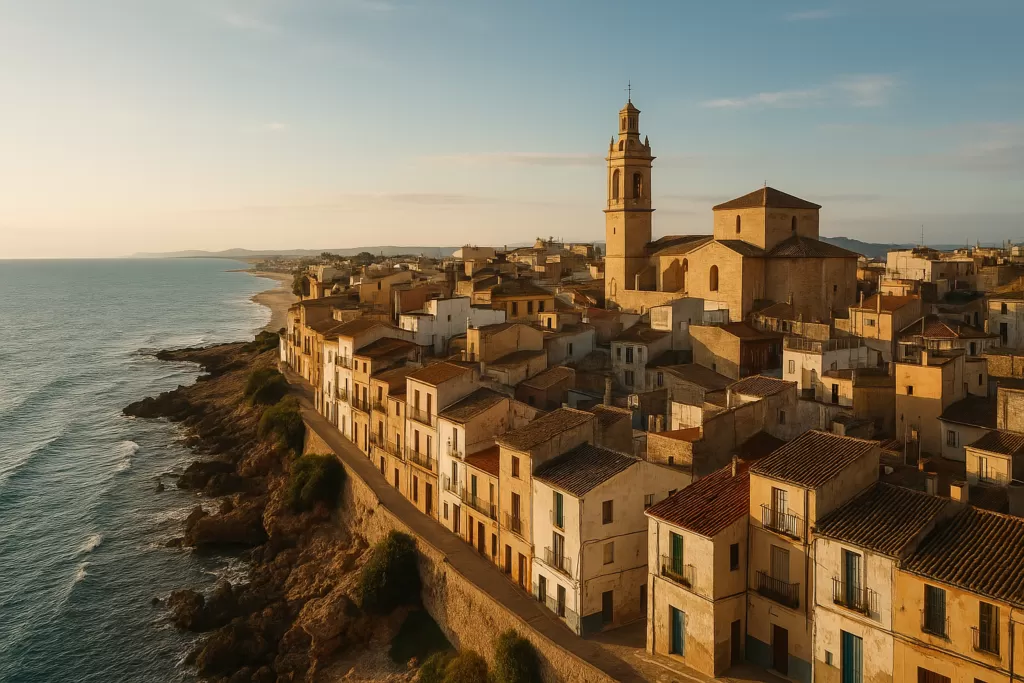
Benifaió: Moorish tower town in the Ribera Alta
Benifaió is a Ribera Alta town of 12,262 people (INE 2025), 22 km south of Valencia, with its own Cercanías C-2 station 0.3 km from the main square. Its landmark is the Torre de la Plaça, a 23 m Almohad-era tower in the Plaça Major that is among the largest surviving towers of its kind in the Valencian Community. Come for a short heritage stop, the August fiestas or an easy base between Valencia, the Albufera and the Ribera orange groves; there is no beach.
Benifaió at a glance
- Municipality in the Ribera Alta comarca, province of Valencia. Spanish name: Benifayó. The town stands at 19 m.
- Population 12,262 (INE 2025); part of Valencia’s outer metropolitan ring.
- Landmark: Torre de la Plaça, about 11 m wide at the base, four floors, about 23 m tall, crowned by seven merlons on each side.
- Second tower: Torre de Mussa (Torre de l’Horta), 0.7 km north-west in the orchards.
- Trains: Benifaió-Almussafes station (Renfe Cercanías C-2) and Font Almaguer (Metrovalencia line 1).
- Distances (straight line): Valencia 21 km, Valencia airport 23 km, the Albufera 10.9 km, coast at El Perellonet 11.9 km.
- Twin town: Valmontone, Lazio, Italy.
Before you plan
The medieval underground galleries beneath the Plaça Major are not open as a visitor route and are not fully excavated. Inside the Torre de la Plaça, restored in 1994–1996, there is a small display of finds from the tower, but we could not confirm current opening hours, so ask at the town hall next to the tower before you go. The October 2024 DANA floods hit the region hard; in Benifaió the damage was mostly to underpasses, roads and parks rather than the old centre.
Benifaió on the map
Beaches, sights and nearby towns with a CostaMap page. Click a pin to open it, or switch to places to stay.
Things to do in the town
All the main sights stand around the Plaça Major and can be seen in an hour or two on foot. Add the Torre de Mussa if you want a short walk into the orchards.
| Attraction | What it is | Price/entry | Best for |
|---|---|---|---|
| Torre de la Plaça | Almohad watch and refuge tower (11th–13th century) with a small archaeological display inside | Ask at the town hall | Architecture and history |
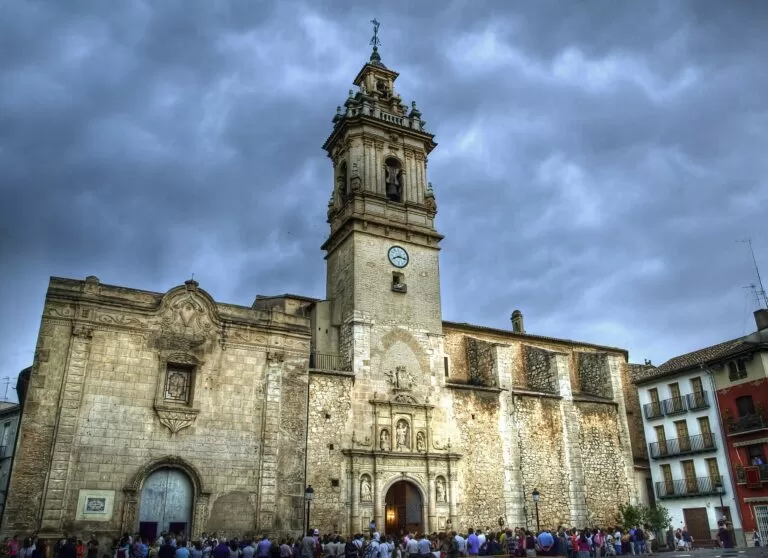
| Església de Sant Pere | 18th-century academic-style church on the Plaça Major with twin bell towers and a tall dome | — | Architecture |
| Palau dels Falcó | Palace of the Falcó family, lords of Benifaió from 1612 to 1872, facing the church | Seen from outside | Local history |
| Torre de Mussa | Second Islamic-era tower in the orchards, later used as a dovecote; 0.7 km from the square | Seen from outside | Short walk, photography |
| Mercat Municipal | Municipal market by the square, open Monday–Saturday mornings (OpenStreetMap) | Free | Local produce |
Torre de la Plaça: what you will actually see
The tower probably dates from the Almohad period (11th–13th centuries) and was one of a ring of towers defending Valencia, with others at Espioca, Silla and Almussafes. People from the surrounding farmsteads sheltered in it. Later it became part of the Falcó palace and the old town hall. When the old town hall was demolished in 1978, the tower was left free on three sides. Over the centuries it served as a granary, a prison and even a dovecote. Inside, the vaults are made of cane and mud, and a steep staircase in the centre climbs through the four floors. Since the 1994–1996 restoration it has held finds from its own excavation: Almohad pottery, Islamic and Christian coins and a Christian storage jar.
The underground galleries
Under the Plaça Major lie medieval galleries from the 15th–16th centuries, built with pointed brick arches. They probably stored the lords’ oil and wine, and a cistern has been found at the end of one gallery, near the old butcher’s shop. They are not open to visitors.
The Plaça Major, Sant Pere and the Falcó palace
The Plaça Major, together with the Plaça del Progrés and the Plaça de l’Àngel, formed the core of the Islamic farmstead. The church of Sant Pere, the third on this site, was begun in the mid-18th century; an inscription dates the east end to 1771. Its canvases by Vicente López and its main altarpiece were lost to fire in the Civil War, but it keeps some 16th-century silverwork. Opposite stands the palace of the Falcó de Belaochaga family, barons of Benifaió. On the road known locally as the Camí del Cid, the simple Ermita de la Mare de Déu dels Desemparats was rebuilt in 1961 after the original was pulled down in 1937.
Best beaches in the area
Benifaió is inland. The nearest coast is around El Perellonet, 11.9 km east in a straight line, south of Valencia. Cullera, 20 km south-east, has the largest beach resort nearby, and the Albufera lagoon is 10.9 km away.
Benifaió with kids
Keep it short: the tower and square make a quick history stop, and children can run in the town’s parks afterwards. Supervise them on the steep staircase if you get inside the tower. For a bigger family day, Valencia’s Bioparc and Oceanogràfic are around 21 km away and reachable by train.
How to get to the area and get around
- By train: Benifaió-Almussafes station (Adif) is on Renfe Cercanías line C-2 between Valencia-Nord and Xàtiva/Moixent, 0.3 km from the square. Font Almaguer station on Metrovalencia line 1 is 3.3 km west, in the Colònia Santa Anna area.
- By bus: Autobuses Buñol links Benifaió with Valencia via Silla, the Ford factory at Almussafes and Llombai. Stops are on Carrer Papa Joan XXIII and Avinguda dels Reis Catòlics. Weekend timetables can differ from weekdays.
- By air: Valencia airport is 23 km away in a straight line.
- By car: the A-7 motorway and the CV-42 (Almussafes–Algemesí) cross the municipality; the CV-520 runs to Alfarp.
- Parking: most car parks OpenStreetMap shows in the centre are private or for customers; there is a car park next to the station.
Where to stay near the tower
Benifaió is mainly residential, so check booking sites for rooms in town. Staying near the station lets you reach Valencia by Cercanías without a car. Valencia, 21 km north, has the widest choice of hotels; Cullera, 20 km south-east, has beach hotels.
Best time to visit the town
The fiesta calendar is full. Sant Antoni Abat on 17 January brings a bonfire, the blessing of rice pots and huge blessed loaves, and a blessing of animals. Five falles commissions burn their monuments from 15 to 19 March. Holy Week has processions by four brotherhoods, and Easter a traditional fair. The patronal fiestas run from 15 to 22 August, including the Festa dels Fadrins for the Divina Aurora on 20 August, with a midday mascletà. Spring and autumn are the most comfortable months for walking.
History of the town
A Roman villa stood on a hill near the lost Font de Mussa: finds include an altar to Mithras (now in the Museu de Belles Arts de València) and, in 2002, a mosaic showing the founding of Rome, now in the Museu de Prehistòria de València. The name comes from the Arabic farmstead of the Banu Hayyun. After the Christian conquest, Benifaió belonged to the parish of Espioca and later became its seat. The lordship passed through several families until the Real Audiencia awarded it in 1612 to Miquel Falcó de Belaochaga, made Baron of Benifaió in 1615; his family held it until 1872. In 1801 the town saw the popular revolt of the Tío Pep de l’Horta. In recent decades orange groves have spread across the irrigated land, and the Ford factory at neighbouring Almussafes is a short bus ride away.
Practical info
- Town hall: Ajuntament de Benifaió, beside the Torre de la Plaça.
- Market: Mercat Municipal, Monday–Saturday 08:00–14:00 per OpenStreetMap (checked November 2026).
- Distances (straight line): Valencia 21 km, airport 23 km, Albufera 10.9 km, Cullera 20.3 km.
- Residents are called benifaioners.
Worth it for: one of the largest Islamic-era towers in the Valencian Community, lively fiestas and an easy train base south of Valencia. Less so if: you want beaches, a large old town or several museums.
How we assess this guide
This is desk research, checked on 6 November 2026. History, the towers, the church, fiestas and transport come from the English and Spanish Wikipedia articles on Benifaió; stations, train lines, bus stops, the market and coordinates come from OpenStreetMap, with straight-line distances we calculated. We did not visit and could not confirm the tower’s opening hours, so ask at the town hall before travelling.
Frequently asked questions
How do I get to Benifaió from Valencia?
Take Renfe Cercanías line C-2 from Valencia-Nord to Benifaió-Almussafes, 0.3 km from the main square. Autobuses Buñol also runs buses from Valencia.
Can you go inside the Torre de la Plaça?
Since its 1994–1996 restoration the interior has held a small display of finds from the tower. We could not confirm current opening hours; ask at the town hall next door.
How tall is the Torre de la Plaça?
About 23 m, on a base about 11 m wide on each side, with four floors and seven merlons on each side at the top.
Can you visit the tunnels under the square?
No. The 15th–16th-century galleries under the Plaça Major are not open to visitors and are not fully excavated.
Does Benifaió have a beach?
No. The nearest coast is around El Perellonet, 11.9 km east in a straight line; Cullera is about 20 km away.
When are the Benifaió fiestas?
The patronal fiestas run from 15 to 22 August. The town also celebrates Sant Antoni (17 January) and the Falles (15–19 March).
What is the nearest airport?
Valencia airport, 23 km away in a straight line.
Plan the wider trip
- Costa de Valencia guide
- Alcúdia: Xúquer-bank heritage town in the Ribera Alta
- Benaguasil: Arab castle town in the Camp de Túria
- Eliana: Valencia Camp de Túria Guide
- Alboraya
- Paiporta
Sources and freshness
Checked 6 November 2026 · 3 sources Show
Checked 6 November 2026. Wikipedia: Benifaió (English) and Benifayó (Spanish). Stations (C-2, Metrovalencia L1), bus stops, market hours, car parks, the two towers and coordinates: OpenStreetMap, © OpenStreetMap contributors (ODbL); straight-line distances calculated by CostaMap. We did not find an official page with the tower’s opening hours, so these are not given.
Nearby on the Costa de Valencia
The nearest town guides on this coast, by straight-line distance from Benifaió.
Places worth knowing near Benifaió
How this page is made. CostaMap is written with an AI editorial system run by Ebizapple. This page is based on the sources listed above. Last updated 6 November 2026. Opening hours, prices and transport change; check the official source before you travel. How we work · Partner links and ads