
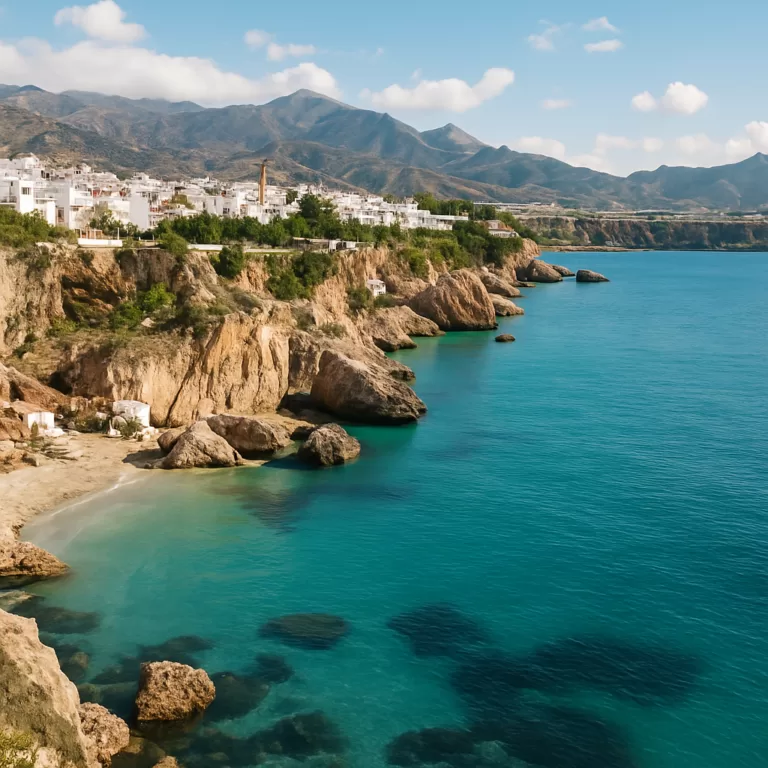
The Costa Tropical is the short, dramatic coast of Granada province, tucked between the Costa del Sol and the wild beaches of Almería. Sheltered by the Sierra Nevada, it enjoys a subtropical microclimate warm enough to grow mango, avocado and custard apple on mainland Europe. It is small and less famous than its neighbours, and that, plus the Alhambra an hour inland, is its quiet appeal. Here is an honest, grounded guide.
At a glance
- Where: Granada province, Andalusia, south-east Spain.
- Gateways: Granada (GRX) and Málaga (AGP).
- Best for: a subtropical climate, quiet coves, and easy access to Granada and the Sierra Nevada.
- Headline stops: Almuñécar, Salobreña, La Herradura, Marina del Este.
- Eat: local tropical fruit, the chirimoya (custard apple) above all, grown in the valleys around Almuñécar and Motril.
- Getting around: a car is the practical way to explore, and it puts Granada within easy reach.
Three things that surprise first-time visitors
- The beaches are pebbly and dark. This is a coast of grey sand and shingle below cliffs, not the golden sweep some expect. The water is clear and deep, which suits swimmers and divers.
- It really is subtropical. The shelter of the Sierra Nevada lets farms here grow mango, avocado and custard apple, an unusual sight in Europe.
- Granada is astonishingly close. You can stand on the Alhambra’s hill in the morning and swim in the Mediterranean the same afternoon.
Almuñécar and Salobreña
Almuñécar is the main resort, and a surprisingly old one, with a Phoenician past, a hilltop castle and the ruins of a Roman fish-salting factory beneath the town. A few kilometres east, Salobreña rises as a cascade of white houses on a rocky crag, crowned by a Moorish castle and ringed by the green of old sugarcane fields.
La Herradura and the coves
West of Almuñécar, the curved bay of La Herradura shelters calm water that has made it a favourite for diving and snorkelling, especially around the small marina at Marina del Este. The coast here folds into a series of coves below the hills, quieter than anything on the Costa del Sol.
The mountains behind the sea
What sets the Costa Tropical apart is what sits behind it. The Sierra Nevada, the highest range in mainland Spain, rises just inland, and Granada with its Alhambra is roughly an hour away. In late winter you can ski in the morning and reach the beach by afternoon, a combination few coasts in Europe can offer.
Local tip
Buy a chirimoya in season, usually autumn into winter, from a roadside stall or local market. The custard apple grown on this coast is one of Spain’s most distinctive fruits, and it barely travels, so this is the place to try it.
Reality check
This is a small coast, and the towns are modest rather than glamorous. The pebbly beaches and limited nightlife will disappoint anyone after a big resort scene. Its strengths are the climate, the calm water and the doorstep access to Granada and the mountains.
Verdict
Come to the Costa Tropical for a quieter base with a great climate and the Alhambra within reach. Stay around Almuñécar or Salobreña, take a day in Granada, and you get sea, mountains and history in a compact, underrated package.
How we assess
This guide is compiled and cross-checked from established, verifiable information about each place, its geography, history, headline sights and food. We do not invent first-hand fieldwork or personal anecdotes. Where something is a matter of taste or shifts with the season, we say so plainly, and place names use correct Spanish spelling and accents.
Which part of the Costa Tropical is for you?
| Area | Character | Best for |
|---|---|---|
| Almuñécar | The main resort, Phoenician roots, hilltop castle | The most facilities and history in one place |
| Salobreña | Whitewashed hill town, Moorish castle | The coast’s most photographed view |
| La Herradura | Sheltered horseshoe bay | Diving, sailing, calm water |
| Motril | The coast’s working commercial hub | A practical base, less scenic |
| Granada (inland) | The Alhambra, under 90 minutes away | A single unmissable day trip |
When to go
The Sierra Nevada’s shelter keeps this coast mild through winter as well as warm in summer, so unlike costas built purely around a July–August season, the Costa Tropical works reasonably well year-round — winter days are rarely too cold to enjoy a coastal walk, even if swimming stays a summer activity. Spring brings the fruit orchards into bloom, which is a genuinely pretty backdrop for a drive through the valleys behind Almuñécar, while high summer is when La Herradura’s calm water and the Salobreña old town are at their busiest with day-trippers from the Costa del Sol.
Getting around once you’re here
Both Granada and Málaga airports serve this coast reasonably well, with Málaga the larger of the two and Granada the closer option if the Alhambra is a priority on the same trip. Once you arrive, a car is genuinely the practical way to see the coast — the towns are strung along a narrow coastal road backed immediately by mountains, and while a bus service connects the main stops, it runs far less frequently than a car-based visitor would want. The upside of driving is that Granada itself becomes a realistic half-day or overnight add-on rather than a separate trip, something few other Spanish costas can offer this easily.
The tropical fruit trade, up close
This coast’s name is not a marketing flourish — the valleys behind Almuñécar and Motril are genuinely covered in mango and custard-apple orchards, a sight found nowhere else on mainland Europe. The chirimoya, or custard apple, has become something of a local signature crop, celebrated with its own festival in Almuñécar each autumn, and roadside stalls selling fruit direct from the growers are a common, worthwhile stop if you are driving the coastal road. Motril, the coast’s least scenic town, is also its economic engine precisely because of this trade, handling much of the packing and export that keeps the valleys in business. It is a working agricultural landscape as much as a holiday coast, and that authenticity is part of what keeps it quieter than its neighbours.
A simple 2–3 day plan
- Day 1 — Almuñécar and Salobreña. The Phoenician ruins and hilltop castle in Almuñécar, then Salobreña’s whitewashed old town and Moorish castle a short drive along the coast.
- Day 2 — La Herradura. A slower day around the sheltered bay, with time for diving or simply swimming in genuinely calm water.
- Day 3 — Granada. An early start for the Alhambra and the Albaicín, easily done as a long day trip or an overnight stay before returning to the coast.
Diving and the marine reserve
The waters off La Herradura and the Punta de la Mona headland form part of a protected marine area, and the seabed here is genuinely rich — Posidonia seagrass meadows, rocky reefs and clear visibility have made this stretch one of Andalucía’s better-known diving spots, with several operators running courses and boat dives out of La Herradura’s small marina. It is a gentler, more sheltered alternative to the more exposed dive sites further along the Andalusian coast. That is part of why it draws repeat visitors rather than one-off day-trippers, and why several dive schools here operate year-round instead of closing for winter.
Beyond diving, the same clear water suits sea kayaking and snorkelling well, and several of the coast’s smaller coves — reachable only by boat or a walk along the coastal path — stay quiet even in August. That is rarer on the more built-up Costa del Sol just to the west, where the same summer weeks bring far heavier crowds to almost every accessible stretch of sand.
In short: come for the fruit, the calm water and the closeness to Granada, and accept the pebbles as the price of the quiet.
Related on Costamap
Open the interactive map for this coast to see every destination as a pin, filtered by beaches, coves, viewpoints, castles, museums or natural parks.
Every town guide on the Costa Tropical
12 towns on this coast have their own guide on CostaMap. They are listed alphabetically, with what each one is actually for.
- Albolote — the Battle of La Higueruela
- Almuñécar — Costa Tropical beaches, a hilltop Moorish castle
- Armilla — trams to the Alhambra, the FERMASA fairground
- Atarfe — The Caliphate-era city of Medina Elvira lies at the foot of Sierra Elvira
- Granada — Timed Alhambra tickets, the Albaicín viewpoints and a free-tapas custom that still holds
- Guadix — Europe’s largest inhabited cave-house district, a grand cathedral
- Las Gabias — The Baños de la Gabia is one of the most unusual late-Roman structures
- Loja — Medieval walls, the Los Infiernos gorge and a landscape shaped by water
- Maracena — Effectively a suburb of Granada now, Maracena is a practical
- Motril — Costa Tropical beaches, 1,000 years of sugar-cane history, a local rum distillery
- Salobreña — a white hilltop town under a Moorish castle
- Santa Fe — ‘the cradle of hispanicity’
See the full Costa Tropical region guide for the interactive map of every beach, town and historic site along this coast.
Frequently asked questions
When is the best time to visit?
The climate is mild year-round, with warm, comfortable spring and autumn and hot summers. Autumn also brings the custard-apple harvest.
Are the beaches sandy?
Mostly pebble and dark grey sand below cliffs, with clear, deep water that suits swimming and diving more than long sandy strolls.
Can I combine it with Granada?
Easily. Granada and the Alhambra sit about an hour inland, and the Sierra Nevada ski resort is reachable in season.
How is it different from the Costa del Sol?
It is smaller, quieter and less developed, with coves instead of resort sprawl and a more subtropical, local feel.
Plan your trip
Browse the interactive Costamap map, where each marker opens its own card. The Costa Tropical sits between two neighbours: the Costa del Sol to the west and the Costa de Almería to the east.
Every place we have mapped on the Costa Tropical
21 towns, beaches, coves and landmarks, kept up to date automatically.
- Alhambra
- Castillo de Salobreña
- Castle of San Miguel
- Granada Cathedral
- Huerta de San Vicente
- Maro–Cerro Gordo Cliffs Natural Park
- Royal Chapel of Granada
- Albolote: Granada Vega Metro Town Guide
- Almuñécar
- Armilla: Granada Vega Town & Shopping Guide
- Atarfe: Granada Vega & Sierra Elvira Town Guide
- Baza: Historic Highland Town near the Sierra de Baza
- Granada: Alhambra, Albaicín and Free Tapas
- Guadix: Cave Houses and Cathedral
- La Zubia: Sierra Nevada Foothills near Granada
- Las Gabias: Granada Vega Heritage Town Guide
- Loja: Granada Genil Valley Town Guide
- Maracena: Granada Vega Metro Town Guide
- Motril: Beaches, Sugar History and the Costa Tropical
- Salobreña: Castle, White Town and Tropical Coast
- Santa Fe: Historic Vega Town where Columbus Signed his Contract
How this page is maintained. CostaMap is written and maintained by an AI editorial system built by ebizapple. Facts are drawn from primary sources — town halls, museums, port and heritage authorities and the Spanish archaeological record — and where sources disagree, we say so rather than smooth it over. Photographs marked as ours are taken on location. This page was last reviewed on 11 August 2026. Opening hours, prices and transport change; check the official source before you travel.