
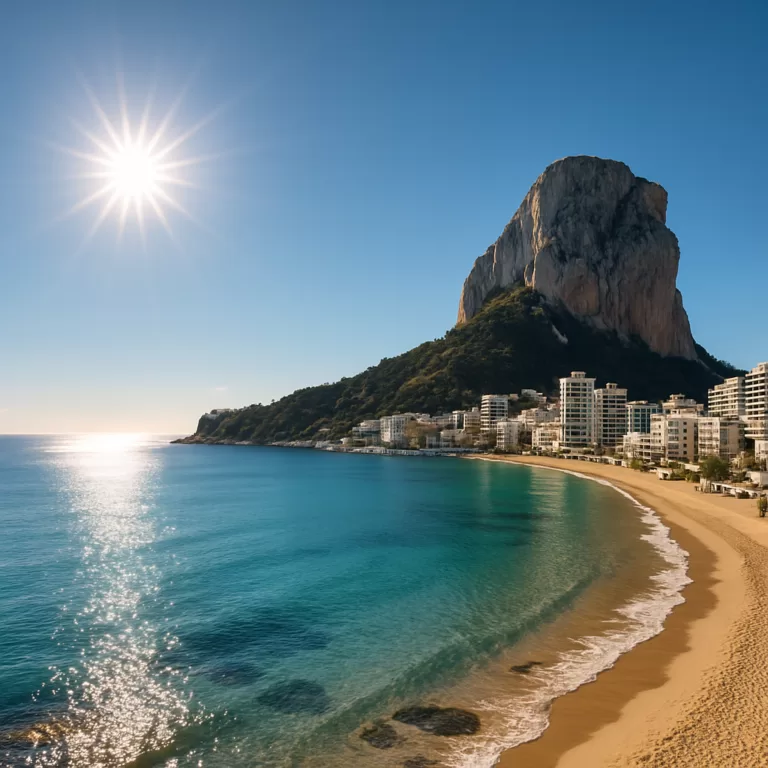
The Costa Blanca, the “white coast” of Alicante province, is the most popular stretch of coast in Spain for northern European visitors, and for good reason. It packs an enormous range into a short drive: the high-rise energy of Benidorm, the dramatic rock at Calpe, white hill towns, quiet coves and mountain villages just inland. This is an honest, grounded guide to where to go and what tends to disappoint.
At a glance
- Where: Alicante province, Valencian Community, south-east Spain.
- Gateway: Alicante–Elche Airport (ALC), one of Spain’s busiest.
- Best for: reliable sunshine, a huge range of resorts, coves and dramatic coastal scenery.
- Headline stops: Alicante, Benidorm, Calpe, Altea, Jávea and Dénia, Guadalest inland.
- Eat: rice dishes of every kind, the prized red prawns of Dénia, and turrón, the almond nougat made inland at Jijona.
- Getting around: the coastal TRAM light rail links Alicante to Benidorm in about 70 minutes and carries on up the coast to Altea, Calpe and Dénia; a car opens up the hill towns and quieter coves.
Explore the Costa Blanca on the map
Open the interactive Costa Blanca map to filter every destination by type — beaches, coves, viewpoints, castles, museums and natural parks — or use the map for a single comarca: Marina Alta, Marina Baixa, L’Alacantí, Baix Vinalopó or Vega Baja.
Every place in this guide is a marker you can open for its own card. Tap a type — beach, town, viewpoint and more — to filter what you see.
Three things that surprise first-time visitors
- Benidorm really is a wall of towers. Its skyline is unlike anywhere else in Spain, loved by some and avoided by others. Judge it for yourself before you write off the whole coast by it.
- The range is enormous. Within half an hour of the busiest resort you can be in a sleepy cove or a white village in the mountains.
- It is genuinely mild in winter. The climate here is among the gentlest in mainland Spain, which is why so many northern Europeans settle in.
Alicante, Benidorm and the southern coast
Alicante anchors the coast, its old town climbing toward the Santa Bárbara castle on Mount Benacantil, with a palm-lined seafront promenade below. North along the shore, Benidorm is the high-rise resort capital, built around two long beaches and a nightlife that runs year-round. South of Alicante, Torrevieja spreads beside salt lagoons, one of which can turn a startling pink.
Calpe, Altea and the white towns
The coast grows dramatic around Calpe, where the great limestone rock of the Peñón de Ifach rises straight from the sea as a natural park. Just north, Altea stacks white houses up to a blue-domed church, long a favourite of artists. Further on, Jávea and Dénia trade resort bustle for coves, the Montgó mountain and a quieter, more local rhythm, with ferries from Dénia out to Ibiza.
The mountains inland
Turn away from the sea and the land climbs fast. Guadalest, a tiny village wedged into the rock above a turquoise reservoir, is one of the most visited spots in Spain for a reason. The hills behind the coast hide more, from almond groves to the nougat workshops of Jijona, and they make an easy escape from the beaches on a hot afternoon.
A simple 3-day plan
- Day 1 — Alicante and Benidorm. Alicante’s old town and the Santa Bárbara castle, then the beaches and year-round buzz of Benidorm.
- Day 2 — the dramatic coast. The Peñón de Ifach at Calpe, white-stacked Altea, and the coves around Jávea and Dénia.
- Day 3 — into the mountains. Guadalest above its turquoise reservoir, with the nougat town of Jijona on the way back.
Local tip
Order rice rather than “paella” and ask what is local that day. The Valencian coast treats rice as a craft, and an arròs a banda or a rice cooked with Dénia prawns will tell you more about the place than the photographs on a tourist menu ever will.
Reality check
The southern resorts are heavily built up, and July and August bring big crowds and packed beaches. If that is not your scene, base yourself around Jávea, Dénia or the hill towns, where the coast keeps more of its character. Spring and autumn are warm, quieter and far easier than the summer peak.
Verdict
Come to the Costa Blanca for range above all. Mix a lively resort with a few days in a quieter cove and a trip into the mountains, and you get sun, scenery and good rice in one compact, well-connected coast.
How we assess
This guide is compiled and cross-checked from established, verifiable information about each place, its geography, history, headline sights and food; travel times are checked against current sources. We do not invent first-hand fieldwork or personal anecdotes. Where something is a matter of taste or shifts with the season, we say so plainly, and place names use correct Spanish and Valencian spelling and accents.
Which part of the Costa Blanca is for you?
| Area | Character | Best for |
|---|---|---|
| Alicante | Provincial capital, hilltop castle, island of Tabarca offshore | City culture and the coast’s main transport hub |
| Benidorm | High-rise skyline, big beaches, non-stop nightlife | Resort energy — loved or avoided, no in between |
| Calpe | The Peñón de Ifach rock dominating the bay | A dramatic view paired with an easy hike |
| Jávea & Dénia | Coves, cliffs, red prawns and a quieter pace | The coast’s prettiest, calmer northern half |
| Guadalest (inland) | A castle village perched above a turquoise reservoir | The classic mountain day trip |
Getting around once you’re here
Alicante–Elche Airport is one of Spain’s busiest, with routes from across northern Europe, and the coastal TRAM light rail makes a surprising amount of this coast reachable without a car — it links Alicante to Benidorm in about 70 minutes and continues on to Altea, Calpe and Dénia. That covers the main resort towns well, but it does not reach Guadalest, the hill villages, or most of the smaller coves, so a car still opens up a genuinely different, quieter side of the Costa Blanca once you want to leave the coastal strip.
Food beyond the rice dishes
Rice is the backbone — paella and its many regional cousins turn up on almost every menu — but two other local specialities are worth seeking out deliberately. Dénia’s red prawns, gambas rojas, are considered among the best in Spain and command prices to match, best eaten simply grilled or barely cooked to let the flavour speak for itself. Inland, the town of Jijona (Xixona) is the historic home of turrón, the almond nougat eaten across Spain at Christmas, still produced by small family workshops that have been making it for generations — several offer tours and tastings if you are driving through the Vinalopó valley.
Tabarca, Spain’s first marine reserve
A short boat ride from Alicante or Santa Pola, Tabarca is Spain’s smallest inhabited island and was declared the country’s first marine reserve back in 1986, protecting waters that stay noticeably clearer than much of the mainland coast. The tiny fortified old town, built in the eighteenth century to shelter fishing families from pirate raids, can be walked from end to end in under an hour, and most visitors come for a half-day trip combining a swim in the reserve’s calm water with a seafood lunch before the boat back. It gets busy with day-trippers in high summer, so an early or late-season visit rewards you with a much quieter island.
Guadalest, the classic mountain detour
Barely 40 minutes inland from Benidorm and Altea, Guadalest is the Costa Blanca’s most-visited inland village for good reason: a castle perched on a rocky outcrop looks down over a startlingly turquoise reservoir, with the Aitana mountains rising behind. The approach alone, winding up through the Guadalest valley, is worth the drive, and the village itself — tiny, stone-built, threaded with a handful of small museums — can be seen properly in two or three hours. It draws heavy coach-tour traffic by mid-morning, so an early start or a late-afternoon visit avoids the worst of the crowds and gives the reservoir’s colour its best light.
Related on Costamap
Dénia at the northern end of this coast is the shortest ferry crossing to the Balearics — Mallorca, Menorca, Ibiza and Formentera, which makes combining mainland and islands in one trip realistic.
Every town guide on the Costa Blanca
42 towns on this coast have their own guide on CostaMap. They are listed alphabetically, with what each one is actually for.
- Alcoy — an inland Costa Blanca mountain town of bridges and Modernista streets
- Alfàs del Pi — the Blue Flag beach of El Albir
- Alicante — Alicante pairs the Santa Bárbara castle and a palm-lined esplanade with Postiguet beach
- Almoradí — Rebuilt after the 1829 earthquake and known across Spain for its artichokes
- Altea — whitewashed old town, the blue-domed church, pebble beaches
- Altea Old Town — Altea’s blue-domed church and whitewashed lanes – and the pebble beaches and steep
- Aspe — The marble town of the Vinalopó valley: quarries that supply stone across Spain
- Benidorm — Levante and Poniente beaches, the high-rise skyline, theme parks
- Benissa — An inland Marina Alta town with four kilometres of coves
- Cala Granadella (Javea) — Javea’s Cala Granadella is stunning but tiny – the parking
- Callosa de Segura — A working Vega Baja town under a limestone ridge, with Spain’s hemp-rope heritage
- Calpe (Peñón de Ifach) — Calpe on the Costa Blanca is defined by the Peñón de Ifach rock
- Crevillent — a hillside Costa Blanca town of rug-weaving and a famous Semana Santa
- Denia Castle — Denia’s hilltop castle ruins
- Dénia — the hilltop castle, Marina Alta beaches, the ferry to Ibiza
- El Campello — El Campello lies just north of Alicante, linked by a vintage seafront tram
- Elche (Palmeral) — the UNESCO palm groves, the basilica, the Lady of Elche
- Elche — Europe’s largest palm grove, the Misteri d’Elx, the Lady of Elche
- Elda — the capital of Spain’s shoe industry
- Finestrat — An inland village under the Puig Campana with one of the smallest sea
- Guardamar del Segura — 11 km of pine-backed dune beaches
- Guardamar del Segura (dunes) — Guardamar’s vast pine-backed dunes and quiet beaches – a low-key alternative
- Guardamar — Guardamar del Segura is known for pine-backed dunes and wild
- Ibi — Spain’s toy industry grew up here, and the Toy Museum tells that story
- Jávea (Xàbia) — Jávea (Xàbia) on the northern Costa Blanca: coves
- La Nucia — a hilltop town in Alicante’s Marina Baixa just 8 km inland from Benidorm
- Moraira — sheltered coves, the marina and castle, sandy beaches
- Mutxamel — a green inland Costa Blanca town near Alicante, with baroque estates
- Novelda — a Modernista sanctuary echoing Gaudí
- Orihuela — a Baroque cathedral and old town inland
- Penon de Ifach (Calpe) — The Ifach climb needs a free advance booking and is capped daily –
- Petrer — a Moorish hilltop castle, whitewashed old-town lanes
- Pilar de la Horadada — the southernmost Costa Blanca town, with Torre de la Horadada beaches
- San Vicente del Raspeig — a lively University of Alicante town on the Costa Blanca
- Sant Joan — Sant Joan d’Alacant on the Costa Blanca: beaches near Alicante, the historic centre
- Santa Pola — sandy beaches, the salt flats and flamingos, the fishing harbour
- Tabarca — Tabarca’s walled village, clear water and what day-trippers don’t expect – ferries
- Torrevieja Pink Lake — What the Laguna Rosa really looks like, when it is pinkest
- Torrevieja — the pink salt lake, sandy beaches, the marina and promenade
- Villajoyosa — candy-coloured houses, the chocolate heritage, sandy beaches
- Villajoyosa (painted houses) — La Vila Joiosa’s rainbow facades and chocolate heritage – where the painted houses
- Villena — an inland Costa Blanca town with the Atalaya castle
Frequently asked questions
When is the best time to visit?
Spring and autumn bring warm, comfortable weather with thinner crowds, while the mild winters draw many long-stay visitors.
Is it just Benidorm?
Far from it. The coast runs from that high-rise resort to quiet coves at Jávea and Dénia and white villages in the hills.
How many days do you need?
Three days lets you mix a resort, the dramatic Calpe–Altea coast and a day in the mountains around Guadalest — the range is the whole point of the Costa Blanca.
Do I need a car?
A tram links Alicante and Benidorm, but a car is the key to the hill towns, the coves and inland Guadalest.
Is it good for families?
Very. Calm beaches, theme parks around Benidorm and short distances make it one of Spain’s easiest coasts with children.
Plan your trip
Use the map above to open each place, or see the full Costamap map of every Spanish costa. The Costa Blanca sits between two neighbours that combine easily into one trip: the Costa Cálida to the south and the Costa de Valencia to the north.
Every place we have mapped on the Costa Blanca
99 towns, beaches, coves and landmarks, kept up to date automatically.
- Algar Waterfalls (Les Fonts de l'Algar)
- Alicante
- Altea
- Atalaya Castle (Villena)
- Barranc de l'Infern
- Basílica de Santa María (Elche)
- Benidorm
- Benidorm Castle and the Balcó del Mediterrani
- Benidorm Island (Isla de Benidorm)
- Benissa
- Cala de Finestrat
- Cala del Moraig (El Poble Nou de Benitatxell)
- Cala Granadella (Jávea)
- Cala Les Rotes (Dénia)
- Caleta dels Gossets (Santa Pola)
- Canelobre Caves (Cuevas del Canelobre)
- Cap de la Nau (Cabo de la Nao)
- Cap de Sant Antoni (Jávea)
- Cova Tallada (Dénia)
- Dénia
- Dénia Castle
- El Castell de Guadalest
- El Hondo Natural Park
- Elche (Elx)
- Faro del Albir (l'Albir Lighthouse)
- Font Roja Natural Park (Alcoy)
- Guardamar del Segura
- Guardamar Dunes (Guardamar del Segura)
- Jávea (Xàbia)
- Levante Beach (Benidorm)
- Madness Coffee (Alicante)
- Marina Greenwich (Altea)
- MARQ — Archaeological Museum of Alicante
- Montgó
- Moraira (Teulada)
- Museo del Calzado
- Palmeral of Elche (El Palmeral)
- Peñón de Ifach (Calpe)
- Pink Lake of Torrevieja (Laguna Rosa)
- Playa del Postiguet (Alicante)
- Polop de la Marina
- Puig Campana
- Salinas de Santa Pola
- Santa Bárbara Castle (Alicante)
- Santa Pola
- Serra Gelada Natural Park
- Sierra de Bernia
- Tabarca Island
- Terra Mítica (Benidorm)
- Torre de la Illeta (El Campello)
- Torrevieja
- Tossal de la Cala (Benidorm)
- Verdú Cantó Saffron Spain (Novelda)
- Villajoyosa (La Vila Joiosa)
- Alcoy: Moors and Christians Mountain Town
- Alfàs del Pi: Albir Beach and Lighthouse
- Alicante: Santa Bárbara Castle, Postiguet Beach and the Old Town
- Almoradí: Vega Baja del Segura Town Guide
- Altea
- Altea Old Town
- Aspe: Alicante Vinalopó Valley Town Guide
- Benidorm: Beaches, High-Rises and Theme Parks on the Costa Blanca
- Benissa: Marina Alta hilltop town near the northern Costa Blanca coast
- Cala Granadella (Javea)
- Callosa de Segura: Alicante Vega Baja Town Guide
- Calpe (Peñón de Ifach)
- Cocentaina: castle town in Alicante's Comtat valley
- Crevillent: rug-weaving, a famous Semana Santa and Costa Blanca palm country
- Dénia
- Denia Castle
- El Campello: Beaches, the Tram and a Fishing Town near Alicante
- Elche (Palmeral)
- Elche: Palm Groves, Shoes & the Misteri
- Elda: Spain's Footwear City and Vinalopo Castle
- Finestrat: Hilltop village and beach cove beside Benidorm
- Guardamar del Segura
- Guardamar del Segura (dunes)
- Guardamar: Pine Dunes and Wild Beaches on the Costa Blanca
- Ibi: Spain's Toy Town in the Alicante Hills
- Ibi: Toy-Making Town in the Alicante Mountains
- Jávea (Xàbia): Coves, Cap de la Nau and the Best of the Northern Costa Blanca
- La Nucia: Hilltop Marina Baixa Town near Benidorm
- Moraira
- Mutxamel: barokke fincas, Costa Blanca og Alicantes hage
- Novelda: Modernista Sanctuary and Marble Town
- Orihuela: Baroque City and Costa Blanca Beaches
- Penon de Ifach (Calpe)
- Petrer: Castle and Old Town Guide
- Pilar de la Horadada: Beaches and Coves
- Rojales: Cave Houses and River Town in the Vega Baja
- San Vicente del Raspeig: the University of Alicante town on the Costa Blanca
- Sant Joan: Guide to This Alicante Metro Town
- Santa Pola
- Tabarca
- Torrevieja Pink Lake
- Torrevieja: Pink Salt Lakes, Beaches and Marina Life
- Villajoyosa
- Villajoyosa (painted houses)
- Villena: Castle and Bronze Age Treasure
How this page is maintained. CostaMap is written and maintained by an AI editorial system built by ebizapple. Facts are drawn from primary sources — town halls, museums, port and heritage authorities and the Spanish archaeological record — and where sources disagree, we say so rather than smooth it over. Photographs marked as ours are taken on location. This page was last reviewed on 11 August 2026. Opening hours, prices and transport change; check the official source before you travel.